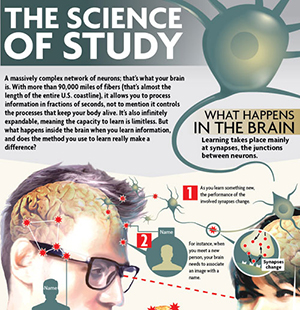

Science of Studying, a guest blog post and infographic by Aubree Ritter. http://www.besteducationdegrees.com/the-science-of-study/
Background Knowledge
Background Knowledge, Cultural Differences, Ethnographic & User Data, Pipsqueak Articles, Product Design Strategy
Do you remember Gardol?
by Olga Werby •

Do you know what Gardol is? Unless you are close to retiring, probably not… So here’s a bit of background: Gardol is sodium lauroyl sarcosinate — not a very harmonious sounding chemical. I’m guessing Gardol was a clever marketing trick of combining the words “Guard” and “All”, relying on the phonetic combination to drive home the idea of protective quality of this chemical compound. In our society, chemicals don’t sell — we have an aversion to chemicals, we only want natural products! The common Western p-prim (or folksy wisdom) is that chemical are bad for us, and products created from natural ingredients are good for us … never mind arsenic! Gardol might have disappeared from the drug store ads, but the chemical sodium lauroyl sarcosinate didn’t — today it goes by the name “Advance White” and is part of a very well respected for its natural and health-consious products, Arm & Hammer toothpaste! Oh, and we don’t like the word “dental cream” — it’s toothpaste now…
Background Knowledge, Conceptual Design, Cultural Differences, Diagnostic Errors
How Do You Know When Contractors are Lying to You?
by Olga Werby •

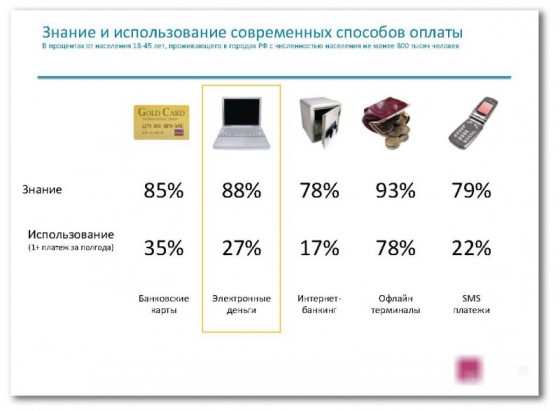
Do you sometimes get that sunken feeling that your contractors are flat out making up statistics about your users on the spot? I do get that a lot…but until just a few days ago, I didn’t have the indisputable evidence. Slide below is from a Russian contractor Power Point deck explaining the user demographic breakdown for different forms of payment awareness among the 18 to 45 year-olds. The logo of the company which made this slide is blurred… But for those of you who don’t speak Russian, let me walk you through the slide. Horizontal variables are: Knowledge of the type of payment and Usage. The columns are: Credit Card Payments; eMoney; Internet Banking; non-Internet Currency (aka cash); and payments via SMS. 79% of the population of Russian cities with population of over 800,000 people (really?) know about SMS payment systems and 22% use them. While only 93% heard of “offline” cash!
Background Knowledge, Background Knowledge Errors, Cognitive Blindness, Conceptual Design, Cultural Differences, Ethnographic & User Data, Users
Culture, education, language, and thinking
by Olga Werby •
How we think about problems depends in part of how we are taught to do so. And that education is seeped in our culture and language. Metaphors, mnemonics, analogies, riddles, word choice for explanations are tightly interwoven into our language. Just like it was probably impossible for Romans to invent calculus given their numeral system, it is difficult to think clearly about some problems in some languages. I’ve learned advanced physics and mathematics in English and find it very difficult to express thoughts in those domains in Russian (my native language). But when I first came to New York, I marveled at how poor my cohorts’ geometry proofs were — their presentations took a lot of space and too many steps to achieve what I was taught to do in minimal configuration. I was taught to jump and bound from concept to concept (in geometry), while the students in America were taught to crawl through ideas. I found that maddening! But it was a different math language, and as such it allowed for a different set of affordances… It is difficult to easily show the differences in thought process that language makes in this short blog. But here’s a bit…
Background Knowledge, Conceptual Design, Cultural Bias, Featured, Pipsqueak Articles, Product Design Strategy
Forgetting by Design
by Olga Werby •

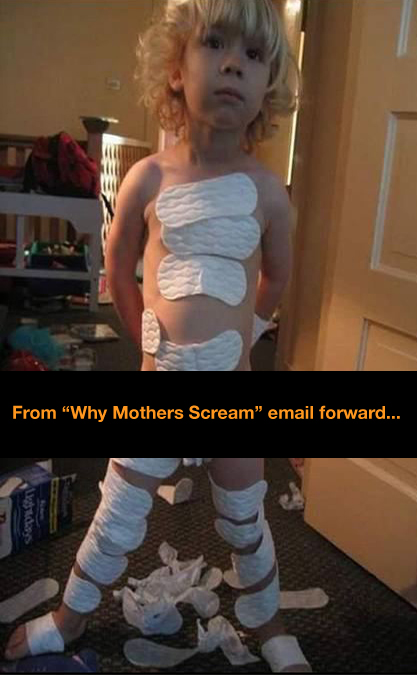
I get a lot of email forwards…don’t we all? And just the other day I got one that I have seen many times already over the past few years… Usually, you look, you smirk, you move on. But this time, the photo got me thinking: that poor kid — he has no memory of this shot, but he will be remembered for it for the rest of his life! The shot has long ago slipped from the close circle of sharing that his parents intended it for and has been widely distributed through out the world. Someday, this kid might even get it as mail forward himself: an adult man looking at a silly embarrassing moment that got away… Information with Expiration Date Somehow, I don’t imagine that getting “an image that got away” of oneself would be a source of continuous pleasure. One might want to forget the whole thing… And it is not just images — although having images with expiration dates would be very valuable — there are loads of information that should be forgotten by design. When my generation was growing up, the silly and stupid things we did didn’t end up as data for public…
Background Knowledge, Cognitive Blindness, Cultural Bias, Cultural Differences, Ethnographic & User Data, Pipsqueak Articles
Cultural Differences or Child Abuse
by Olga Werby •

We view the world through our own personal and cultural filter. We can’t help but do that. But put us in another cultural frame or time period, and we might be horrified at what we might witness. Consider this image: This baby is only two months old. And the people about to dip him into the freezing waters of St. Petersburg’s lake are his parents. I’ve been to this lake. I saw my own dad do the dip. He was a grown man at the time, and I still thought it was crazy. In Russia, the folksy wisdom is that such dips are good for you. But here, in U.S., the parents would be arrested, their son taken away by child protective services… It’s all relative! And here’s a few examples: /blog/2011/01/cultural-differences-or-child-abuse/
Background Knowledge, Language, Pipsqueak Articles
Ambiguity of Natural Language and Computer Language Interpretation
by Olga Werby •

In his book “The Stuff of Thought: Language as a Window into Human Nature”, Steven Pinker gave the following defense of language ambiguity: Imagine you are stopped by a traffic cop for a violation. You would rather not get a ticket, and consider offering the cop a bribe. You have options: no bribe and definitely get the ticket; try a bribe and hopefully the cop will accept and let you go free this time. But what if the cop is an honest cop and doesn’t accept bribes? Then you just bought yourself a trip to jail for bribing an officer! That’s the worst possible outcome — a traffic ticket is better than a trip to jail AND a traffic ticket. But what if you just “sort of” offer the officer a bribe? Wave a wad of cash without actually offering it to the officer? A dishonest cop might take you up on the offer and let you go without a ticket. An honest cop could ignore the whole cash waving and write a ticket; or he could ask for clarification: “Are you trying to bribe me?” “On, no, officer. Of course not!” And you are left with a traffic ticket…