Language allowed us to meet people we never came face to face with, to learn about events that happened far away in time and space. Written stories expanded that capacity exponentially. Stories made us human.
Language allowed us to meet people we never came face to face with, to learn about events that happened far away in time and space. Written stories expanded that capacity exponentially. Stories made us human.
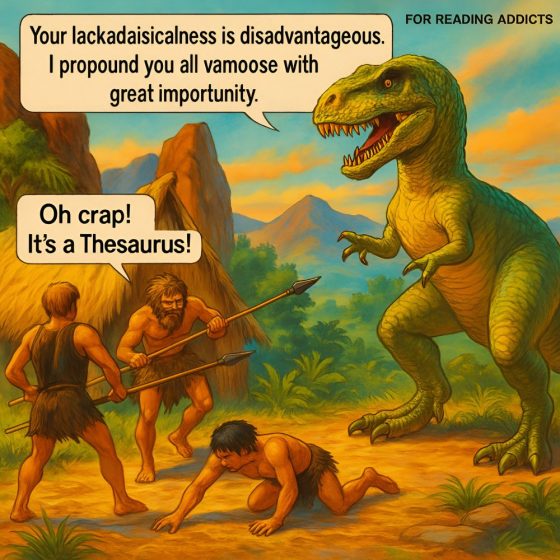
Words help us remember. Words sharpen our senses and help us give shape and texture to everything we observe. Words have interesting sounds and mouth feel. The word “zebra” doesn’t only conjure up a striped ungulate, it pleasantly vibrates on our lips and tongue. It’s fun to say. The word “power” pushes out with force. It can even produce spittle. It’s aggressive. The word “emolument” is slippery, almost slimy. It feels like something unpleasant is rolling in our mouth. “Sun” doesn’t only describe our star, but it feels bright. “Onomatopoeia” is a mouthful, and it describes words that suggestively sound like the ideas they represent. “Bang” is both the sound that something makes and the word used to describe that sound. “Splat” is another example of a word that mimics the sound. And so is “buzzer” — another word that makes our teeth vibrate. Human languages are full of onomatopoeic words. In our household we use the word “pook” to refer to farts. It’s a Russian word, but easily understood and remembered by an English speaker. Consider what happens when you look at a series of images. As they are flashed on the screen, you don’t need language to identify…
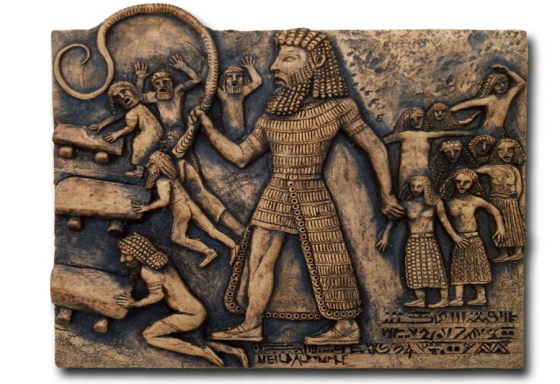
Can natural selection and evolution work on man-made objects and structures? Can it work on the stories we tell ourselves as a society? Products, architecture, and stories are continually evolving and selecting for traits that we and our influencers find more useful and appealing. Unfortunately, lots of interesting designs and solutions get overlooked along the way. Like evolution, luck is a major component of the force that decides what stays and what goes.
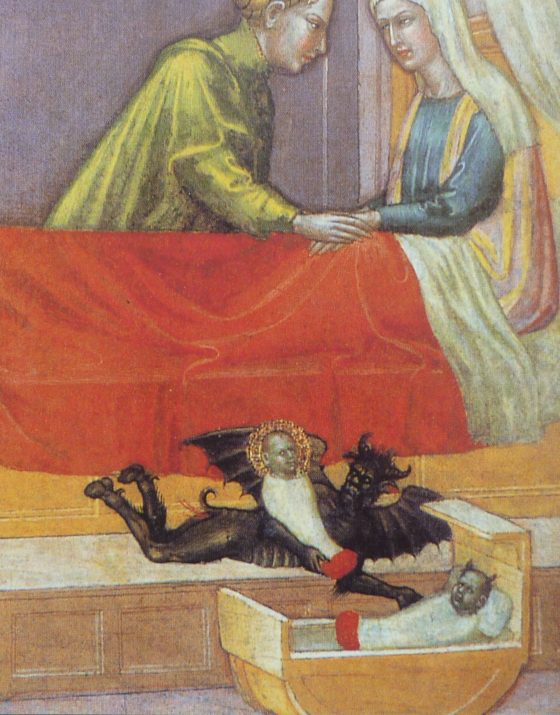
We define ourselves by the stories we tell each other. Myths, fairytales, fantasy, scifi, fiction, drama, superhero movies, et., they are all different ways to look at ourselves in a mirror. Consider metal illness and cognitive developmental disorders.
It’s the start of a summer and thus a start of a county fair season. This year felt different — the carny people were gone!
I am a bit late to the ChatGPT bandwagon — people all over the internet are pointing out badly written prose. But I did want to give it a try. I have hundreds of story ideas that I have jotted down over the years. Most won’t ever be written into an actual story. So it seemed like a fun exercise to give ChatGPT an assignment of writing a short story using some of my notes as prompts. I tried three, iterating on one of those multiple times to see what differences my suggested changes made to the AI-generated story. The results are at the end of this post. The first thing I noticed is that all of the ChatGPT stories were flat — there were no unexpected twists or turns; and the endings sounded the same, each with a strange bit of morality embedded for good measure. The AI had a bit of literary echolalia — some phrases were repeated over and over again. It’s like it liked saying “like” as a verbal tic. I didn’t expect that. Stories tended to start with “In the world…” and conclusions began “In the end…”. The strangest response I got out of ChatGPT…
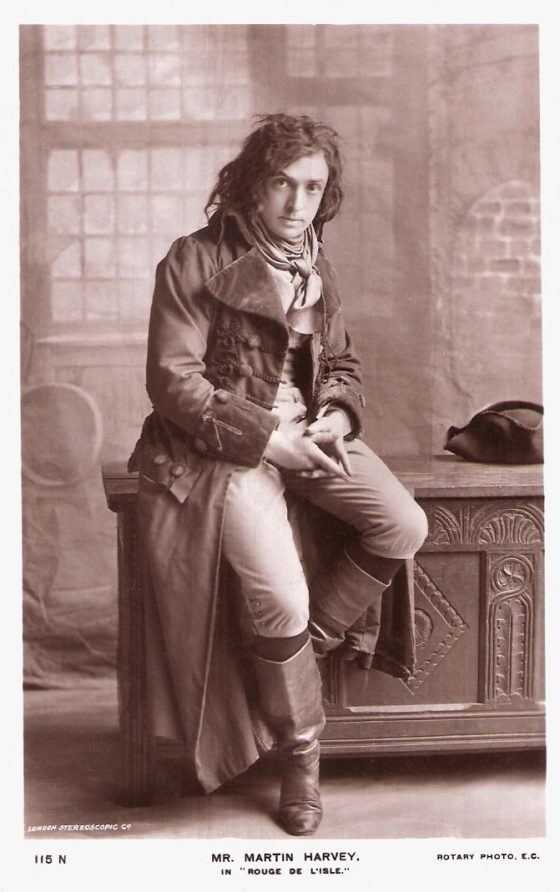
Phrontistery is an ancient Greek word meaning “a place for thinking.” I love cool words and phrontistery not only feels good on the tongue, but its meaning really appeals to me — it describes a space specifically dedicated to thinking! For many people, bathrooms are a perfect phrontistery. They are for me, too. Showers score high as well. But I think I do my best thinking when I write. With my fingers on the keys, I can clarify my thinking and also discover ideas that must have been hovering around my subconsciousness, ready to be revealed to my eyes through my fingers. Writing is a metaphorical phrontistery for me. And probably in the days when diaries and journals were popular, many others found capturing words in a tangible medium clarified one’s thoughts and opinions on all sorts of matters. Luckily for my friends and family, I write mostly fiction — my phrontistery cleverly hides the true identities of many. Lately, I have been devouring books at a high rate. As a result, my little collection of notes (over a thousands and counting) has been growing. I consider my notes app as part of my phrontistery. I jut down ideas for…