Crisis Mapping Crisis mapping is a relatively new field—there’s not much research, no journal, and the Harvard Humanitarian Initiative (HHI) and the Department of Political Science at John Carroll University (JCU) jointly hosted the first International Conference on Crisis Mapping only in October 2009. So this is a NEW field of study and practice, but there is a thriving group of practitioners with Patrick Meier (one of the developers of Ushahidi) being one of the leading members. Since I’m working on organizing a conference proceedings for ICT & Human Rights, it seemed necessary to define a few terms in this subject area filled with TLA (three letter acronyms). There are some important terms that are being developed to help parse the field and make sense of the different aspects of the problem. Here’s a breakdown: Crisis Mapping can be divided into three main components: Crisis Map Sourcing (CMS)—this is all about data point collection Crisis Map Coding (CMC)—refers to entering the data points by hand, based on analysis of news, police reports, blogs, and so on, but the person entering the data is a professional Participatory Crisis Mapping (PCM)—refers to data points entered by the population in crisis, requires people…
Background Knowledge
Background Knowledge, Background Knowledge Errors, Causal Net Problems, Diagnostic Errors, Group Decision Errors, Mental Model Traps, Pipsqueak Articles, Product Design Strategy
e-Waste & Product Design
by Olga Werby •
I just came across a very interesting video by Annie Leonard. She’s been making little, approachable documentaries that explain difficult to understand issues—e-waste being one of those. Here’s her latest: The Story of Stuff. This is the story about how stuff gets designed, made, distributed, and then trashed. The Story of Bottled Water. This is the story about drinking water and the marketing of bottled water.
Background Knowledge, Background Knowledge Errors, Contributor, Errors, Interaction Design, Interface Design, Mental Model Traps, Product Design Strategy, Scaffolding, Users
More is always better – Or so most think!
by Mallika •

Tugend, A., (2010). “For the Dishwasher’s Sake, Go Easy on the Detergent.” NY Times Online. Visited on November 04, 2010: http://www.nytimes.com/2010/03/13/your-money/13shortcuts.html If dishwashers do not seem to be doing their job or if your clothes are not coming out as soft as you’d like them to, or if these machines break down easily, it is most likely due to “user error.” We throw in multiple fabric softener sheets because more is better. More isn’t better in this case! The excess sheets liquefy when the dryer gets hot and gum up the dryer. Most people use ten to fifteen times the amount of soap they need. This excess soap is detrimental to the life of the machines. This article has some clear implications for interaction and interface design. User errors are likely to happen. Even if you have a manual with detailed instructions, the chances of somebody reading that manual are very slim. Even if they read it, they are still likely to err. How can design inculcate the right usage in the user? In this case, what can design do to prevent errors resulting from the ‘More is better’ p-prim? Possible Interaction Design Solutions: Solutions could be…
Background Knowledge, Conceptual Design, Contributor, Cultural Bias, Cultural Differences, Flow, Interaction Design, Interface Design, Product Design Strategy
Using Computers to Teach Children Without Teachers
by Sheetal Elangovan •
Johnathan, F . (2010). “Using computers to teach children with no teachers” BBC News. Retrieved on 21 July, 2010: http://www.bbc.co.uk/news/technology-10663353?print=true Summary of the article: The article summarizes studies conducted by Prof Mitra on the learning curve of children using computers for education with teachers. Results of the study prove that the teaching methods employed have been quite successful based on the fact that: Children who are not exposed to computers are highly motivated to teach themselves skills they want to learn Children have had a steep learning curve in picking up complex tasks with minimum supervision Learning by discussion and in groups ensures that content is retained and not skimmed through by children. Motivation levels of students are kept high with a grandmother figure in the picture. The best results of the study have been combined to create Self Learning Environments where children in groups of 4 share a computer to assimilate information. Virtually present volunteer grandmothers keep the student motivated and support the learning process. On Environment: The need for self-organized learning essentially arises in developing nations and the ones who do not have access to education. Children living in such conditions have a natural survival instinct, which keeps…
Attention, Attention Controls Errors, Background Knowledge, Perception, Perceptual Blindness, Perceptual Focus Errors, Pipsqueak Articles
Perceptual Illusions
by Olga Werby •
Our minds play tricks on us all the time. Once the information has entered our cognition via our senses, it still has to get processed to be understood. Like any other data, it’s all about context. For interesting examples of optical illusions, please visit http://www.lottolab.org/articles/illusionsoflight.asp. R. Beau Lotto has put together a few interesting examples of mis-processing! Or watch him deliver a talk at TED.
Anchoring Errors, Background Knowledge, Background Knowledge Errors, Causal Net Problems, Diagnostic Errors, Featured, Mental Model Traps, Metaphor Mistakes, Misapplication of Problem Solving Strategies, Pipsqueak Articles, Product Design Strategy, Scaffolding
What is a p-prim?
by Olga Werby •

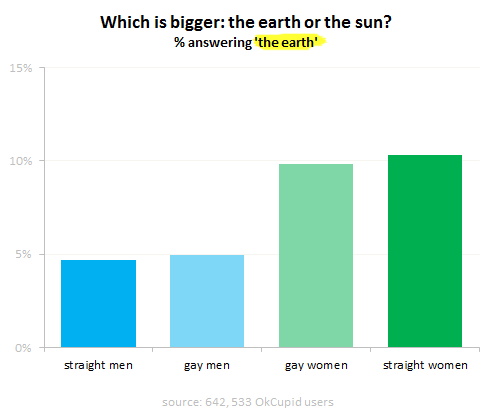
I’ve been using the p-prim ever since I’ve learned of them, back in my graduate school days at UC Berkeley. P-prims stand for phenomenological primitives and were “invented” by Andrea diSeesa, a UC Berkeley professor in the School of Education who also happens to be a physicist (diSessa, 1983). Visit his Wikipedia page and check out some of the cool projects he’s working at now. Before I give a definition of a p-prim, I think it would be good to give a few examples. Here’s a graph published by OkTrends on beliefs of various groups (in this case as defined by their sexual orientation) about the relative size of our sun versus the Earth (our planet). Even disregarding the differences in percentages due to sexual preference, an awesome 5 % to 10 % of our population believes that the planet we live on is larger than the star it orbits. Would this qualify as a p-prim? Yes: it’s not a formally learned concept; it describes a phenomenon; it’s a bit of knowledge based on personal observations: the sun looks like a small round disk in the sky; it’s a useful problem-solving tool when one has to draw a picture with…
Background Knowledge, Background Knowledge Errors, Mental Model Traps, Misapplication of Problem Solving Strategies, Pipsqueak Articles
Grabbity and Other Folksy Wisdom
by Olga Werby •

We spend our lives engaged in problem solving: When should I leave the house to get to work on time? What can I make for dinner given the stuff in my refrigerator? How much work do I need to get done today in order to leave a bit earlier tomorrow? What’s the best driving route given the traffic report coming over the car radio? Can I make the this green light? Can I talk my way out of a traffic ticket? What’s the maximum amount I can pack into my trunk after a COSTCO run? How can I get that stain off the carpet? Is this blog good-enough to post? Looking over this sample list of problems, it’s easy to see that some have to do with temporal and spatial processing (e.g. packing the trunk, picking the best route, judging speed, making schedules), some with background knowledge manipulation (e.g. coming up with a recipe given a list of ingredients, looking up cleaning strategies), some with social processing (e.g. ability to analyze social situations and make correct predictions of possible outcomes—”I will get that ticket, if I run that red light.”), and some with metacognitive tasks (e.g. judging quality, comparing standards…