
Tag Archive for social value

Advancing the New Machine UCLA Law Forum Presentation

Today, I presented UCLA Law Forum at the Advancing the New Machine human rights conference in Berkeley. Below is an approximation of my presentation. How many of you have ever used a chair to reach that jar of tomatoes on the top shelf? I do it all the time. I’m the shortest member of my family and I use chairs as my personal hight extension. And I know I’m not alone. People are opportunists. We use products to get what we want. We subvert existing technologies to reach our own goals. From phones to cameras, from crisis mapping to photo editing, from news papers to forums, we manipulate and use tools and features to accomplish what we want, what we need. And we don’t necessarily use those tools for what they were designed for originally… As product designers, we need to be able to harness this opportunistic behavior to accomplish what we want. We want to direct crowds down the path that’s most productive and more aligned with goals of our projects. Two years ago, I came to The Soul of the Machine Conference to learn who are the players and what projects showed promise in using technology to advance…

Washing Machines and Education

Hans Rosling is a professor of International Health at Karolinska Institute in Stockholm, Sweden. (He has been featured on this blog before—“No More Boring Data”.) For me, the most important point Dr. Roseling makes in this TED presentation is that time-saving technology raises the general level of education in the community and women in particular.

Knowledge, Context, & Expectation

These are three necessary components of any product design: Knowledge: the background information that forms the foundation of product design Context: the ecosystem in which the product will be used Expectation: the alignment of goals between product creators and the users for which it was designed A failure to fully understand any of the above variables results in errors that propagate throughout the product system. But what if the product is disaster preparedness? Consider the design of an evacuation plan ahead of a disaster. You would need to understand the what kinds of damage the disaster is capable of wrecking; the probabilities for each outcome; the people and the ecosystem in which the disaster will occur; and expectations of all the participants in the evacuation plans. Tsunami and The Zoo A few years ago, I was teaching a fifth grade science class where we were discussing the possible damage from a tsunami in San Francisco (we just visited the Bay Model). The problem I posed to the students was to design a reasonable evacuation plan for The San Francisco Zoo animals. The Zoo lies on the tsunami flood plane, and as far as we knew there was no plan for…

Information Scaffolding

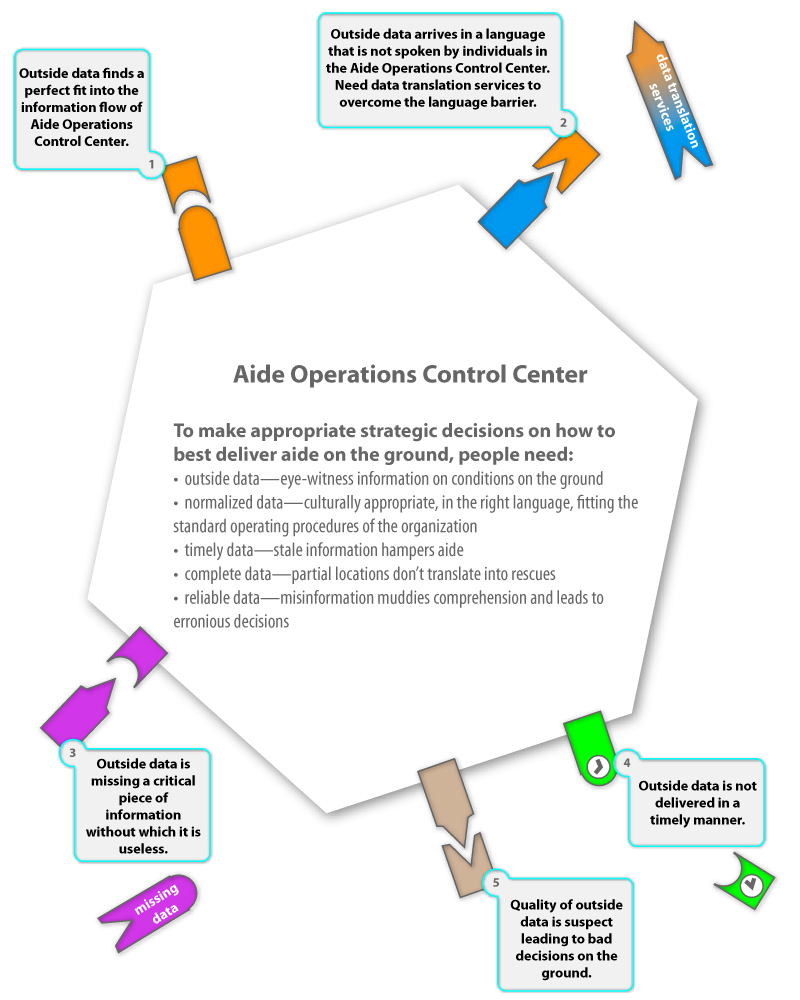
Here’s another way of thinking about crisis mapping as an ecosystem or a cell with a membrane allowing certain information to enter while keeping other out. Some data has data “receptors” in the organization and thus “gets in”. But some information doesn’t and some just doesn’t have the right format: wrong language, incomplete information, time delay, low quality, etc. Please let me know your thoughts on the communicative value of this illustration. Thank you! And here’s how Ushahidi can help.

Augmented Reality in Design

For those of you who have been designing iphone apps that use the geo-location features, social media connections, and tie-ins with local businesses, here are a few ideas and platforms that might help push your projects along to completion. In particular, if you’re considering developing a shopping iphone app (shopping lists, price comparisons, coupons, bulk purchases with friends, and sale alerts), this is worth watching. Argon, the Augmented Reality Web Browser Blair MacIntyre, director of Argon Project, and associate professor in Georgia Tech’s College of Computing, describes the new platform for smart phone (iphone) that uses the same tools as those used to develop web sites. Ad-dispatch Augmented Reality Video This video shows how iphone can be used to interact with packaging, ad, and billboards. What is daqri? This video shows off a piece of software which allows “rich spatial media experience”: Daqri.

Remarkable Design

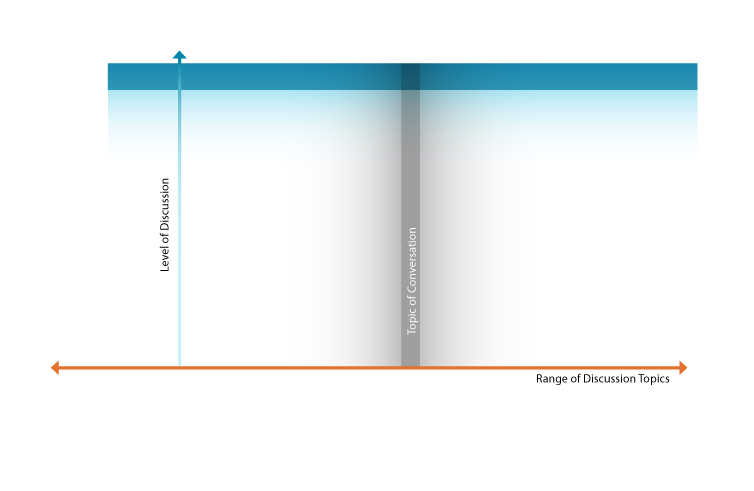
How does one design a remarkable product? “Well, it depends on a product,” some would say. But couldn’t we say something general? Why do we feel passionate about some products but not others? Consider conversations: some are fun, some are boring; some engage lots of people, some not so much; some result is heated exchanges, some are more neutral. Note that you can be very passionate about a topic, but don’t consider it fun: rape, genocide. Politics engages lots of people, but the details leave most bored. Some conversations generate sustained interest, and some fizzle out without a remark. What’s required for a conversation to be remarkable? That depends on the audience. To be engaged in a discussion, you have to find the topic interesting to you. And what’s interesting to you, might not be to me. Thus the topic of conversation is a variable of the targeted audience. Even if you find the topic amusing, you might not have the time to participate in the conversation. “I would love to talk to you about quantum space time, but the plane leaves in 5 minutes.” And it is so noisy on the plane that you can only hear every other…