Pipsqueak Articles

Posts written by Olga Werby or Christopher Werby

Fun, Creativity, and Good Design

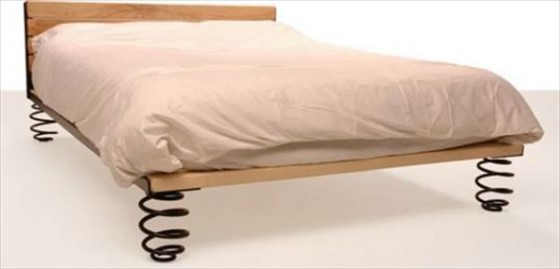
springy bed frame

The best product designs not only work well, they make us smile. They solve problems we as consumers haven’t even consider yet or realized we had. Take a look at a selection of product designs below. The springy bed frame is not only functional, but a conversation starter — don’t you want to try it out? The “selfy stick” helps us take better photos of ourselves. Our arm reach is no longer a limitation or a liability — I like my portraits taken from the top to reduce that double chin! It’s fun to be elegant… until it all crushes down around us. Finger tip tray is the solution! Finger food will stay safely on top of the tray with this cool design. And again, it’s a conversation starter — a perfect tool at a party. While I’m not sure I would advertise my waist size with this imaginative belt, it could serve as a powerful reminder to keep to a diet. Serving tea to your aunt? Wouldn’t this put a smile on her face? In one of my design classes, a student proposed a bed light that would adjust to awaken the sleeper gently. This one does it with…


Review eBook: Affordances and Design

Manches a Gigots

Victor Kaptelinin, a Professor at the Department of Information Science and Media Studies, University of Bergen, Norway, and the Department of Informatics, Umeaa University, Sweden, just published an eBook with Interaction Design Foundation: “Affordances and Design.” I was asked to write a review of this book and provide some insights into using affordances in interaction design and HCI. Let me start by providing the definition of affordance as given by Donald Norman: In his eBook, Victor Kaptelinin provides the history of the idea of affordance from its initial introduction by James Gibson in 1977 to the present day. The eBook’s bibliography and reference section is a great place to start the exploration of this topic for anyone new to these ideas. Unfortunately, the book doesn’t help much if an individual is looking for some guidance on how to apply these ideas in practical situations during interaction design or HCI design. For clarity’s sake, allow me to give a very brief explanation of affordances, from their roots to the present time. When James Gibson first introduced the concept of affordances, he focused on physical environment — what actions are possible? And the set of these action were invariable — just because…

Language and Cultural Differences in Communication

Kulula Plane Decorations

Above is an example of Interface Design — Kulula Airlines decorates its planes in a very playful manner. Does this choice make you feel safer or more reticent to fly their planes? Well, that depends… Consider the FAA Passenger Briefing Guidelines: 14 CFR 91.519. Below are a few examples: § 91.519 Passenger briefing. (a) Before each takeoff the pilot in command of an airplane carrying passengers shall ensure that all passengers have been orally briefed on: Smoking. Each passenger shall be briefed on when, where, and under what conditions smoking is prohibited. This briefing shall include a statement, as appropriate, that the Federal Aviation Regulations require passenger compliance with lighted passenger information signs and no smoking placards, prohibit smoking in lavatories, and require compliance with crewmember instructions with regard to these items; Use of safety belts and shoulder harnesses. Each passenger shall be briefed on when, where, and under what conditions it is necessary to have his or her safety belt and, if installed, his or her shoulder harness fastened about him or her. This briefing shall include a statement, as appropriate, that Federal Aviation Regulations require passenger compliance with the lighted passenger sign and/or crewmember instructions with regard to…

Language, Culture, and Communication

Where we come from — our background culture: our country of origin and language, our heritage and religion (or lack thereof), our family, our education, our friends, and where we live — has an enormous impact on our ability to communicate. What’s more, when people from different cultural backgrounds try to interact with each other, these differences can cause catastrophic failures. Direct versus Indirect Communication Styles Consider the following set of remarks about doing homework: Do your homework! Can you start doing your homework? Would you mind starting your homework now? Let’s clean the table so you can start your homework. Do you need help with homework? It’s getting late, do you have a lot of homework? Didn’t you say you have a lot of homework? Johnny’s mom said that he has a lot of homework today… Do you have everything ready for school tomorrow? Look how late it is — it’s almost time for bed. You have school tomorrow. Each of the statements above represents a progressively less direct command to do homework. In my family, I usually pick number 2 to communicate my desires for finished homework to my sons (although number 1 is perfectly acceptable, to me).…

Tools to Jump-start Product Design Process

product design proposal: user groups

I often encounter the Blank Page Syndrome among our clients. They have an IDEA, but find it difficult to translate the nebulous desires into plans and actions that become a business. I hear a lot: “I know what I want, I just don’t know how that gets translated into something tangible.” The problem though is that most times, these individuals don’t know what they really want. And my job as a designer is to do product design therapy to uncover the real needs and separate them from vague desires. There are a few strategies for this (cognitive scaffolding for the design process). From the point of view of the final product, it is important that the client buys into the ideas and makes them their own. When I hear my words spoken back to me a few weeks into the process, I feel more confidant that the final result will be the practical manifestation of my client’s desires. Define the Categories of Product Users When one runs a business, selling products or providing services, it’s important to keep in mind that in most cases it’s not about you (typical mirroring error). The products and services have to appeal to end…

Health, Human Rights, and Maslow’s hierarchy of needs

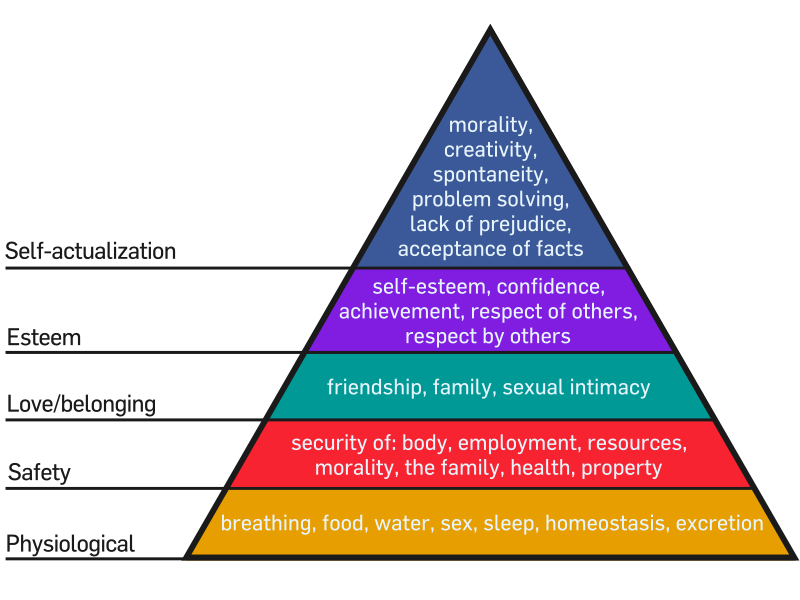
Mazlow's Hierarchy of Needs, used under the Creative Commons

In 1943, Abraham Maslow published a paper on human motivation: “A Theory of Human Motivation.” The ideas (and diagram) from that paper have been widely used in business schools and management training programs. But these same ideas can be applied to human rights. The Universal Declaration of Human Rights, signed into life by UN General Assembly on 10 December 1948, just five years after the Maslow’s publication of “A Theory of Human Motivation”, echoes the work via a set of Articles stating the rights of every human being. Physiological Needs Article 25 of The Universal Declaration of Human Rights states that everyone is entitled to the right of adequate food (and presumably water is included), housing and clothing (for homeostasis control), and medical care. The right to medical care implies to me the right to live healthy, or at least healthy to the best of ability of a particular individual. This right to medical care as a universal right of all human beings can be interpreted to mean many things. For the purposes of the comparison to the Maslow’s Hierarchy of Needs, it could be interpreted as every human has the right to have their physiological needs met. This could…