Background Knowledge Errors

What is a p-prim?

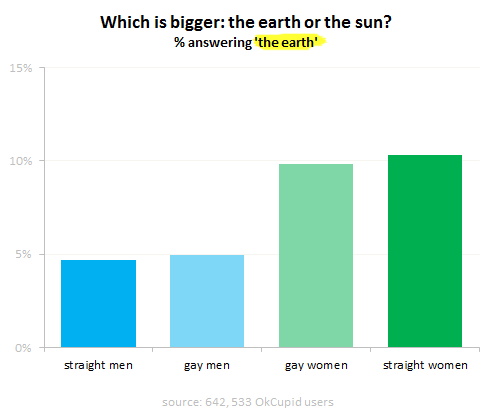
Beliefs on the relative size of Earth versus the Sun.

I’ve been using the p-prim ever since I’ve learned of them, back in my graduate school days at UC Berkeley. P-prims stand for phenomenological primitives and were “invented” by Andrea diSeesa, a UC Berkeley professor in the School of Education who also happens to be a physicist (diSessa, 1983). Visit his Wikipedia page and check out some of the cool projects he’s working at now. Before I give a definition of a p-prim, I think it would be good to give a few examples. Here’s a graph published by OkTrends on beliefs of various groups (in this case as defined by their sexual orientation) about the relative size of our sun versus the Earth (our planet). Even disregarding the differences in percentages due to sexual preference, an awesome 5 % to 10 % of our population believes that the planet we live on is larger than the star it orbits. Would this qualify as a p-prim? Yes: it’s not a formally learned concept; it describes a phenomenon; it’s a bit of knowledge based on personal observations: the sun looks like a small round disk in the sky; it’s a useful problem-solving tool when one has to draw a picture with…

The History of Usability

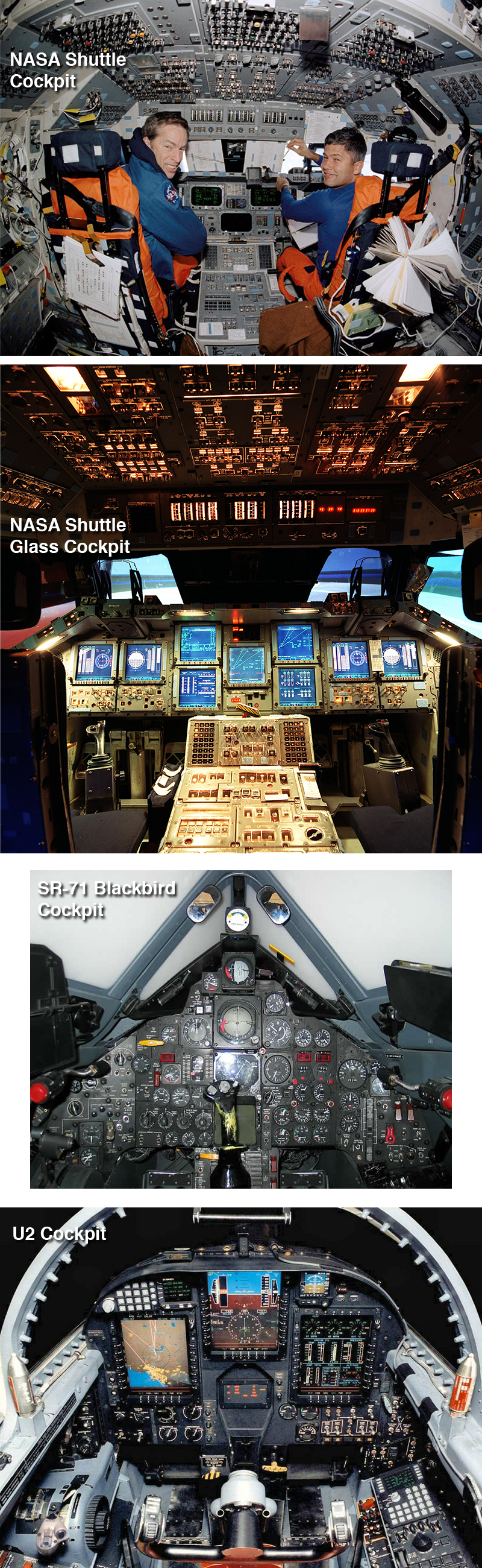
NASA Space Shuttle SR-71 Blackbird U2 Cockpit Designs

When did we start being concerned with usability? Some will say that such concern is part of being human: cavemen worked their stone tools to get them just right. Interaction design mattered even then. But the field of usability research really came into being when the tools we used started to run up against our cognitive and physical limitations. And to avoid hitting literal, as well as psychological, walls, it was the aviation engineers who started to think about usability seriously. While cars were becoming ever more sophisticated and trains ever faster, it was the airplanes that were the cause of most usability problems around WWI. Cars were big, but didn’t go very fast or had a lot of roads to travel on at the turn of the century. In the first decade of the 20th century, there were only 8,000 cars total in the U.S. traveling on 10 miles of paved roads. In 1900, there were only 96 deaths caused by the automobile accidents. Planes were more problematic. For one thing, the missing roads weren’t a problem. And a plane falling out of the sky in an urban area caused far more damage than a car ever could. Planes…

Grabbity and Other Folksy Wisdom

We spend our lives engaged in problem solving: When should I leave the house to get to work on time? What can I make for dinner given the stuff in my refrigerator? How much work do I need to get done today in order to leave a bit earlier tomorrow? What’s the best driving route given the traffic report coming over the car radio? Can I make the this green light? Can I talk my way out of a traffic ticket? What’s the maximum amount I can pack into my trunk after a COSTCO run? How can I get that stain off the carpet? Is this blog good-enough to post? Looking over this sample list of problems, it’s easy to see that some have to do with temporal and spatial processing (e.g. packing the trunk, picking the best route, judging speed, making schedules), some with background knowledge manipulation (e.g. coming up with a recipe given a list of ingredients, looking up cleaning strategies), some with social processing (e.g. ability to analyze social situations and make correct predictions of possible outcomes—”I will get that ticket, if I run that red light.”), and some with metacognitive tasks (e.g. judging quality, comparing standards…

Perception & Context

It’s All About Context When it comes to real-estate, it’s location, location, location. When it comes to design, it’s context, context, context. Consider the following scenario: you are going shopping at Good Will. You see a brand new coffee maker for $10. “Oh My God,” you say, “that’s incredibly expensive!” You don’t buy it. You go to Starbucks and see the exact same coffee maker on sale for $120. You get it—how can you pass up such a bargain? In a different setting, the perception of price of the coffee maker resolves as cheap even as the actual price is higher. Why? Why do we care about the context in which the product is sold as opposed to some other intrinsic characteristic? There are people who buy empty Tiffany’s blue boxes and cases. Why? So they can place jewelry and other gift items in there. The mere fact of being inside a blue box makes those object more valuable—they work harder. Again, the perceived value it’s not just in the intrinsic characteristic of an object in a box, but rather in the combination of the two: the product and its context. If a gift-giver tells you that the present you’re…

Science vs. Media: Degree of Public Involvement

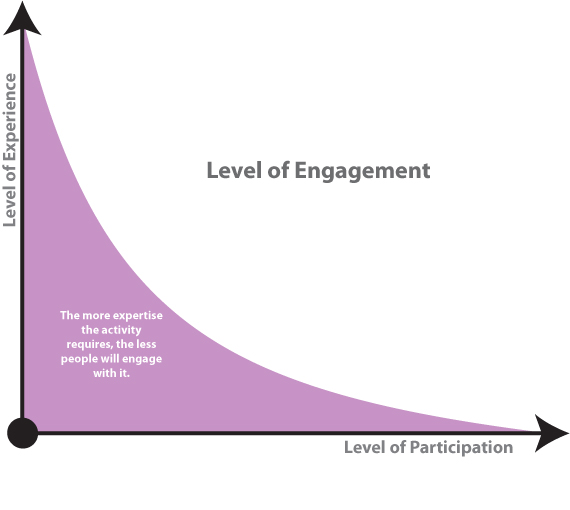
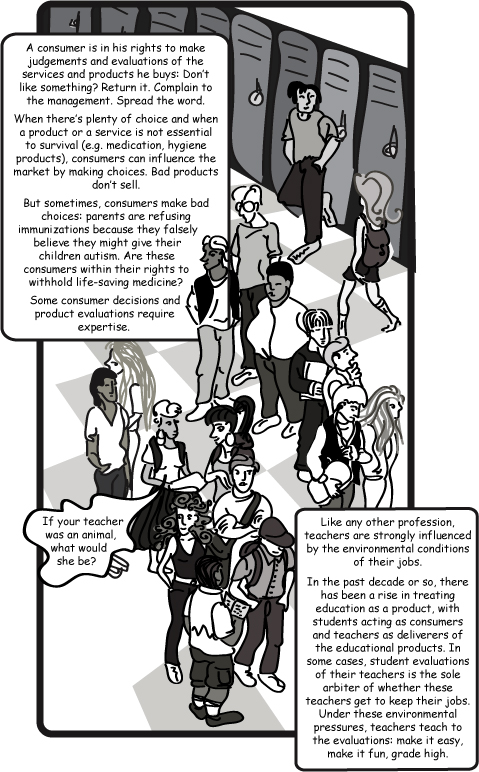
Recently, there has been an explosion of public discourse (fueled by the media) on whether we should do away with tenure in our institutions of higher learning. The basic argument boils down to “tenured teachers can do as they please due to job security and education suffers as the result.” Tenured professors, we are told, focus on research and publishing incomprehensible articles aimed at a few individuals in the world who could even understand them. What’s the use in that, people ask? My son/daughter/neighbor’s kid are being taught by a TA (with poor language skills) while we pay thousands of dollars for the privilege of these children attending universities with all those lazy good-for-nothing tenured professors! You might say that my summary of this world-view is extreme and simplifies the ideas to their comic representation. But that’s the point: the articles (and the readers’ comments they inspire) are written to get an emotional response. The issues of tenure, of the research that these tenured professors are engaged in and the articles they publish, and of teaching styles are complex. To evaluate the contribution of a scientist to his field, one needs to have a certain amount of expertise in that…

Metacognition Failure: If I find it easy, it must not be important

Making something easy to understand is extremely difficult. A good designer knows this, knows how hard one has to work to make something comprehensible and easy to use. Unfortunately, users and consumers of products (including education) tend not to get it. We live in society ruled by “More is Better” p-prim: more stuff is better, more money is better, more food is good, more medication is great…more, more, more. Movies, television, newspapers, magazines, all reinforce this idea in our minds. We live in a “super-size me” world. But this basic decision-making algorithm leads to very faulty reasoning. There are multiple corollaries to the “more is better” axiom: thick books without graphics are more educationally valuable, more important (this is based on research I did many years ago with 5th graders); longer essays are clearly better and should get higher graders (the students worked harder/longer on them); big words are better than small ones in expressing ideas (thus we get very pretentious writing); work should be judged by the time it took to complete and not by the quality of the results it produces; more expensive clothes (cars, stereos, etc.) are clearly more valuable (this is a true statement, but most…