Personality

A Pantser or an Architect?

Pantsing

I’ve described my writing style as one of a “pantser.” When I start writing a story, I don’t have an outline, just a vision. I discover what happens as I go along. That is not to say that I don’t have an idea of the destination; it’s just that I find my way there by feel, by the seat of my pants, or, as others prefer, by planting a garden full of ideas and watching what grows — a “gardener.” Other novelists’ approach writing completely differently. The “architects,” as those writers are sometimes called, like to have a full outline of their story, a well-defined world and its magic systems, and carefully worked out characters before they begin writing. You can say that the “pantsers” and the “architects” are at the opposite ends of story crafting spectrum. Obviously, no one is 100% pantser, and few people are perfect architects. Most are somewhere along the continuum. Personally, I do have the shape of a story in mind before embarking on the journey of writing a book. I have an idea about the characters, and I’ve sketched out the setting in my mind. But I’m often surprised where the story leads me.…

Of Marshmallows and Masks

Marshmallow Test

Most everyone in my family, most of our friends, and a lot of our neighbors have received at least one COVID vaccination shot! It is starting to feel like this year-long nightmare is winding down. And we are lucky to live in the right country and in the right state and in the right city where things are likely to get back to normal sooner rather than later. No one can deny that this had been a very difficult year. But part of the difficulty had been our own behavior. It is quite possible that if we heeded the science and recommendations from the doctors (not the politicians), we would have been here sooner with fewer lives lost and less devastation to our economy. So why didn’t we do all we could to arrest the progress of this devastating disease? Why did we take stupid risks? Why did some people refuse to wear masks and self-isolate? Well, consider the Marshmallow Test. In brief, a Marshmallow Test is an experiment that tries to measure the delayed gratification quotient. A child is given a marshmallow (or any other small but highly desired reward) and asked to wait alone in the room with…

Us and Them

Warm versus Competent graph

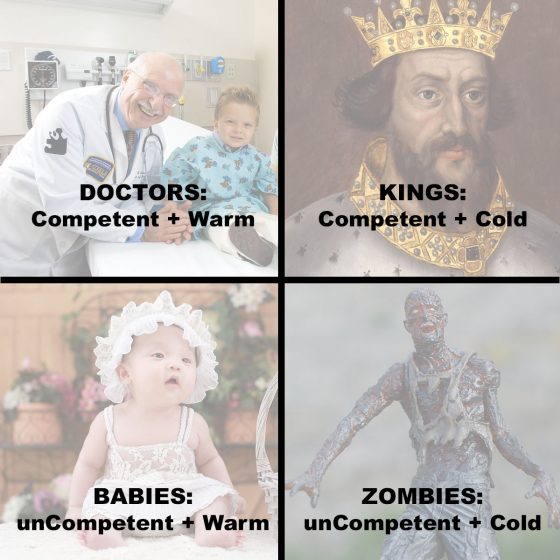
Of Doctors, Babies, Kings, and Zombies Before starting my journey as science fiction writer, I got a few degrees under my belt — astrophysics, mathematics, cognitive science, education, etc. It took a few decades (I’ve gotten married and had a family in there somewhere), but I got my doctorate and have used and still use it to help people think through complicated problems, mostly in product design. How is this relevant to writing, you might ask? Well, in addition to witnessing and surviving some amazing situations — always a good experience for a writer — I’ve acquired a few tools on how to think about situations and people. I would like to share one such tool with you: Us versus Them, a cognitive perspective. What people (and other animals) are very good at is dividing themselves into Us’es and Them’s. It’s a useful tool when we live in a divided world — how else do we keep clear of our allegiances to countries, sports teams, and political parties? But these divisions have neurological and psychological underpinnings. Consider a four square graph that charts competency versus likability (emotional warmth and approachability): We perceive (our) doctors as warm, personable, and able. We…

Cultural, Psychological, and Evolutionary Basis for Your Political Choice in 2016 Presidential Election

2016 Election

Who’s your choice for president this election? How did you make your decision? Given where you live and who you are, you might never really had a choice! Your vote might have been decided for you even before you were born… Might. Cultural Argument: Empathy versus Sympathy There is a lot of talk about the presidential candidates that start with: Who would you rather have beer with? Why does such a question have resonance? Why do we put so much importance on our ability to relate to the candidate? Why do we feel that our ability to visualize ourselves hanging out with a potential president somehow qualifies them for office? Many pundits and TV personalities try to convince us that it matters one way or another. But why does it work? Why do people believe them? Well, there is actual is a reason, and it just happens to be culturally-based. It is worth looking at another example that has nothing to do with people running for the Office of the President of the United States of America. Consider mental illness. How do you feel about a person with schizophrenia? How do you feel about a person with Post Traumatic Stress…

Changing Profiles: The Missing Edit Button

  Social media sites such as Facebook, LinkedIn, and Twitter have changed the nature of digital identities. The anonymous or pseudonymous online profiles of the 90s have been eschewed for real and “verified” identities. However, why do websites force us to conform to variables that describe our identities according to inflexible database fields? Identities are fluid by nature and change over time. We adopt nicknames and change them. We marry and change our surnames. We remarry and change them again. We endure ordeals in life and change our names to distance ourselves from threatening people or violent events. We change our names to avoid responsibilities. We even play with identity and names as an expressive art form. Though government agencies are adept at tracking the various forms of our identities, the common social media and web services that we use daily are not so willing. For example, Facebook has name standards. Their standards limit personal expression. They encourage people to use “real names” but names are subjective and contextual. In fact, the California law that governs identity recognizes that a name others use for you, even if not your “real name” can be legally valid. Furthermore, the “usage method” of the…

Flattery — the Social Lubricant

Gentle Readers, As you have been undoubtably aware for some time, this blog aims for audience with well above average vocabulary and IQ. You and your fellow readers are a very select group with strong interest in science and product design. You are scientists, engineers, and intellectuals. You have an amazing sense of style and fashion. You are able to see patterns and spot details that escape most of those around you. How do I know? I can see the strong engagement with the material on this blog — it’s all there in black and white numbers provided helpfully by Google day in and out. Some of you might think this letter cynical. But all of you know that this content appeals directly your amygdala — you are as happy to be recognized for your brilliance as I’m for your continued readership of my writing. You all know you are special, and you want to be acknowledged as such by those around you. And not only are you all above average, you are also extraordinarily lucky. Some might call this the “optimism bias”, but you and I know that your chances of success are much higher than the average Joe…