Monthly Archives: October 2012

Social Media Election

SOCIAL-MEDIA-ELECTION_Featured_Image

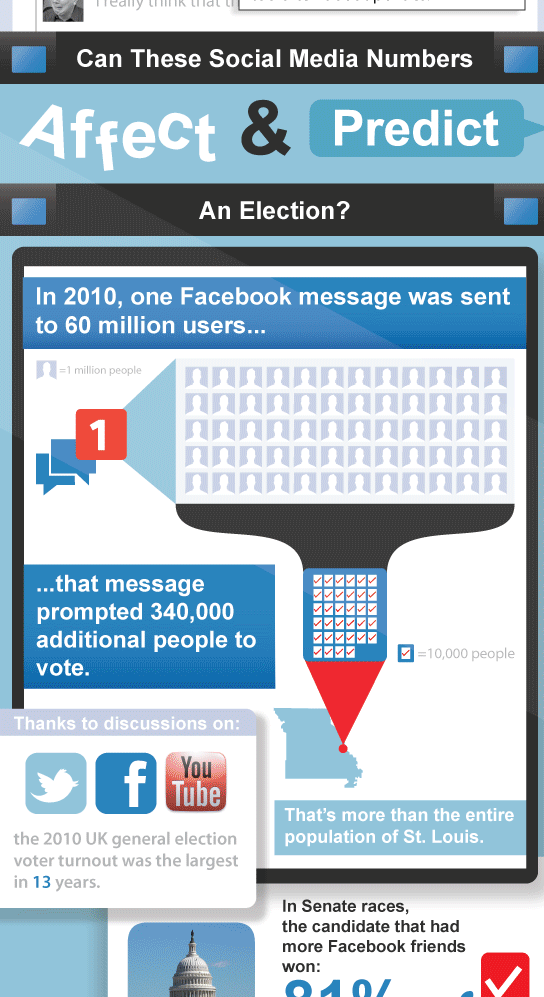
The creative folks at Open-Site.org invited me to share the following informational graphic with the readers of this blog. Anyone with a Facebook or Twitter account has probably noticed an increase in the number of political postings over the past few years. This is due, in part, to the explosive rise in social media outlets and users. But voters are not the only people who use social media; among politicians, 9 out of 10 Senators and Representatives have Twitter accounts. However, many are starting to wonder if social media is becoming less a reporter of political races and more of a predictor of the results. In Senate races, the candidate with more Facebook friends than his or her opponent has won 81% of the time. And one email sent to 60 million Facebook users prompted an additional 340,000 people to vote in the 2010 election. This infographic illustrates just how politics and social media are affecting each other.

RE: Mac vs. PC gap is the narrowest since ’90s.

Gross, D. (2012). “Mac vs. PC gap is the narrowest since ’90s.” cnn.com. Visited on October 9, 2012: http://www.cnn.com/2012/07/05/tech/gaming-gadgets/mac-vs-pc-graph/index.html This article focuses on the recent trend that the ratio of Windows-based computers sold to Apple’s Macintosh computers is tightening to a 20-1 ratio. The article attributes this trend to the rise in use of portable computing and a perception that MacBook laptops are a superior product. Factoring in other portable devices from Apple such as iPods, iPads and iPhones decreases Microsoft’s sales advantage to a 2-to-1 ratio. Conceptual Design The article suggests that an integrated mobile device (laptop or hand held) that is perceived as a “better” product has led to the turnaround in sales for Apple in relation to Microsoft’s widows based PCs. When accounting for Apple’s smart phones and tablets the sales ratio tightens dramatically suggesting a post-PC era that will require product designers to think of new ways to take advantage of this portable computing trend. People spending more time on these non-PC devices threatens Microsoft’s Windows platform that has dominated the software industry for decades. Interaction Design The sales trend in a post PC world where devices are with you at all times suggests that people…

Echo Chamber of Search Results

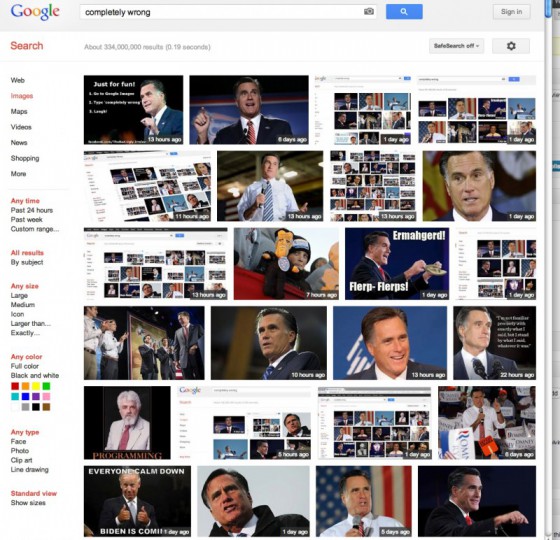
The other day I got an email urging me to check out the search results for “completely wrong” on Google Image Search. Here they are: The results are clear: it seems like Mitt Romney dominates the “completely wrong” search results! But look closer: Eight out of twenty results shown are just screen grabs of the search results! The more people notice and talk about the search results, the more data points they generate for the search results… and here’s my contribution!

The Language Comprehension Continuum

Below is an example of communication error — Penn and Teller use strong emotional language and delivery to hide the true meaning of the message. In context — a pretty young woman anxiously and passionately asking individuals at a faire to protect the environment — signing the petition makes sense. People sign many petitions. And the more people sign (or the more signatures they see on the petition), the more likely others sign as well. A woman, seemingly in distress over an environmental problem, inspires an emotional reaction — people want to help. We have a built-in social value system that encourages this kind of behavior. And finally there’s a strong p-prim that all chemicals are bad — so just hearing a chemical compound in a petition gets a response from the crowd. The result? On the language comprehension continuum, these faire goers didn’t do so well…

BRIDGE to Health

This week, I was invited to attend a BRIDGE Summit at Stanford. I was there to represent Ushahidi’s work and wasn’t particularly sure what to expect… But it turned out to be a very interesting brainstorming session for a new product/service in the health space: BRIDGE. Dr. Stephen Friend (M.D. and PH.D., president/co-founder/director of Sage Bionetworks) ran the show. What you will read below are just my notes, ideas, and understanding of what we were trying to do. I’m sure others at this summit came away with a whole different set thoughts, but, in the interest of advancing my own understanding and sharing of ideas in general, it seemed worth putting together a narrative of the product we were designing. So what is BRIDGE? After a two day discussion, we settled that BRIDGE is a platform (rather than an app) that will strive to: help gather medical information; crowdsource algorithms that would act on collected data with an aim to make medical advances; provide services to patients (information, education, support); facilitate research and make it easier for scientists to get access to data and to post requests for crowdsourcing projects; ease communication between all individuals and organizations working to advance…