
Monthly Archives: March 2012

Special Preview: Visual Aesthetics

Terry Herbert Gold Sward Decoration

Interaction-Design.org is doing an amazing job of developing a textbook for Human-Computer Interaction (HCI) Design. This newest chapter, Visual Aesthetics in human-computer interaction and interaction design by Noam Tractinsky works to tease out the aspects of design that make products appealing, memorable, culturally-appropriate, emotionally satisfying, and beautiful. Beauty & Aesthetics Evolve in Time It’s good to remember that what we find beautiful and appealing changes and evolves in time as well as across cultures. Here’s a wonderful demonstration: 500 Years of Female Portraits in Western Art. What Makes Design Beautiful? In the Interaction-Design.org chapter, Tractinsky starts with Vitruvius’ design principles. Vitruvius lived in the 1st century BC and develop a set of standard criteria by which to evaluate architecture: Firmitas — durability or life-span of the building in relation to its purpose; Utilitas — usability of the building by its intended audience; and Venustas — the beauty of the building (this would be culturally-specific). 2,000 years on and we still talk about durability, usability, and aesthetics of products. Since this chapter discusses architecture, I would like to talk about weapons. Weapons pre-date architecture, but they still follow the same rules for design: durability and reusability, usability, and beauty. If you’ve…
Special Preview: Activity Theory

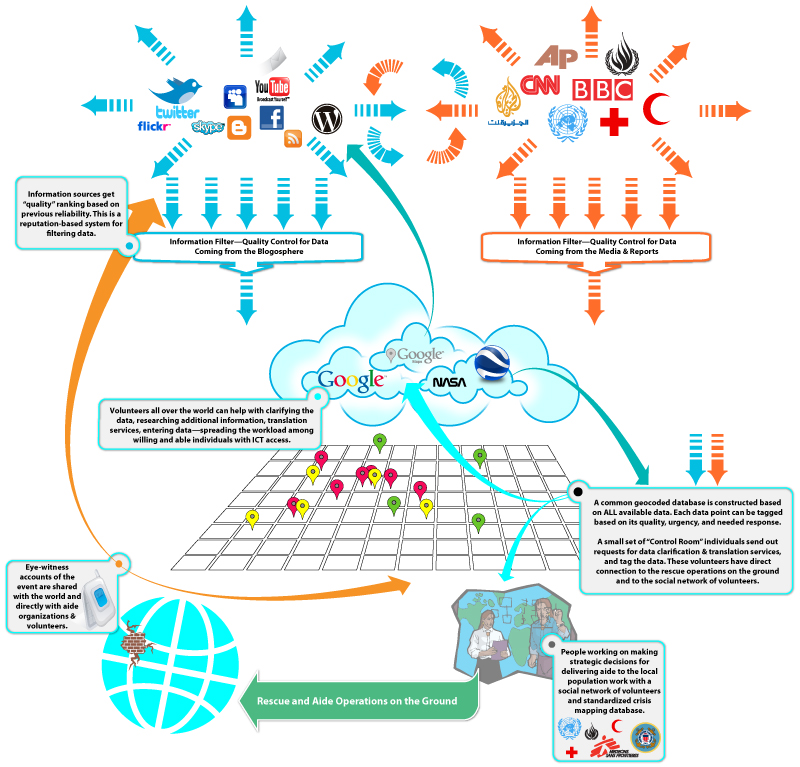
Crisis Mapping Illustration

Once again, we get an early preview of the next chapter of Interaction-Design.org textbook: Activity Theory. The author of the chapter, Victor Kaptelinin, did a wonderful job of summarizing decades of research in educational psychology, cognitive science, and HCI — from Vygotsky to Moran. If you’re unfamiliar with the theories, research, and thinking that brought us to present day HCI design, this is a great place to start (and includes all of the references to the relevant literature). Adopting an activity-theoretical perspective has an immediate implication for design: it suggests that the primary concern of designers of interactive systems should be supporting meaningful human activities in everyday contexts, rather than striving for logical consistency and technological sophistication. While this chapter focuses mainly on human computer interaction (HCI), I would argue that we need to be broader: we need to focus on product design. And as always, I mean product to be interpreted in a very broad sense. We are moving rapidly into a world where everything we touch is a computing device. Today, I Twitted that my washing machine is an ICT device — the new ARM chip is small, requires very little power, and will be incorporated into everything.…

Information in the Age of ICT: the Guardian Newspaper 3 Little Pigs Ad

The 2012 Guardian newspaper ad really captures the flow of information in the age of ICT (Information Communication Technologies). The ad retells the story of the 3 little pigs, their houses, and the big bad wolf. It shows how stories change with spin and through propagation through social media: twitter, Facebook, email, etc. Well done!