
Perception

Distilling Information

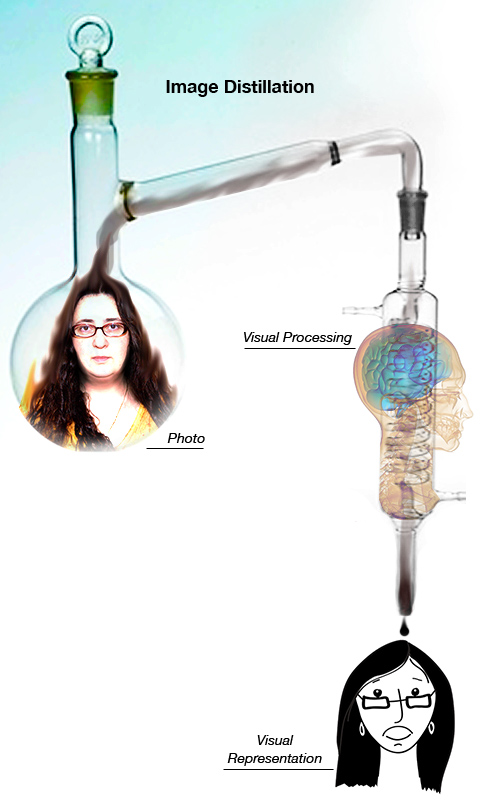
When it comes to my students’ participation in this blog, it’s all about distilling information found in the news to something product designers in our midst would find useful, on a practical level. Consider the illustration below. We see a person’s face (mine in this case). We can describe some of the features. But what do we actually remember? Remembering complex visual information is hard—too many details. Recalling a drawing is easier. That’s because an artist already distilled the complexity into its essential parts—only those details that are required to remind us of a particular individual are included in the rendering. We are all pretty good at judging wether a portrait looks like the person it was intended to represent. We can quickly say if it does or if it doesn’t. But it would be difficult to explain what details in the illustration make the likeness or what’s missing from the drawing that didn’t hit its mark. Distillation of information is hard. Some people are good at it, some are not. It’s an acquired skill. And each category (e.g. sensory like visual, audio, tactile or knowledge-based like physics, economics, biology) requires its own training and its own set of talents.…

A Disease That Allowed Torrents of Creativity.

Article: Blakeslee, S. (2008). “A Disease That Allowed Torrents of Creativity.” NY Times. Visited on 8 April 2008 http://www.nytimes.com/2008/04/08/health/08brai.html This article gives an account of Anne Adams experience with the degenerative brain disease, frontotemporal dementia (FTP). The disease, whose cause is as of yet unknown, leads to the degeneration of the frontal temporal lobe. Three variants of the disease have been identified based on the types of behavioral changes exhibited in the patient.  The first is characterized by personality changes such as increased apathy, loss of motivation for personal care, and weight gain. The two other variants deal with language control. In one case the patient experiences a loss of language while in the other the spoken language network disintegrates such that the patient is no longer able to speak. Anna Adams had the third variant known as primary progressive aphasia (PPA). In Anna’s case, as one part of her brain deteriorated another portion strengthened in order to compensate/ or as a result of the nutrient availability/ or ???. From Anna’s and other patient’s cases, doctors have learned that “that when dominant circuits are injured or disintegrate, they may release or disinhibit activity in other areas. In other words, if one part…

Web Site Design: Are We Doing It Right?

Article: Cliff, A. (2000). “Web Site Design: Are We Doing It Right?” Retrieved 23 May, 2000. http://www.clickz.com/cgi-bin/gt/en/pm/pm.html?article=1757 In order to understand how people see and obtain information from websites, the Poynter Institute conducted an eye-tracking study that measured in which order people see the elements on a page, how long the eyes stayed focused on each element and how text and graphics links were used to navigate through the site. The study was conducted using news websites and the results were surprising. The findings showed that the readers were more attracted to text than graphics, images and photos. This is contrary to the findings from the study conducted before on newspapers where the readers were first attracted to the photos on a page, then headlines, then text. Web designers have taken the approach to create sites that would look similar to print materials for brand consistency, however, this tells us that the process of obtaining information from the web is different than that of reading print materials, and applying the same techniques as creating print materials in creating websites should be reconsidered. The results also showed that since the graphics were not getting much attention, the banner ads would also…