Perception

Mathematical Landscapes Of My Childhood And Their Loss

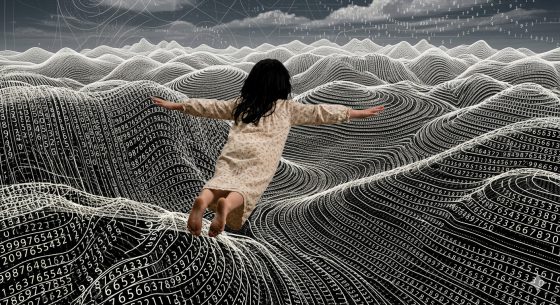
Mathematical landscape with girl flying over it

When I was a kid, I slept in my grandparents’ bedroom. First in a crib, then on a little couch in the corner of their room. My grandfather taught me math every night before I fell asleep. He drilled me on addition, subtraction, then multiplication. He used large numbers; and I always got the right answer. It was easy for me. Numbers formed a complex landscape that I could fly over. In the darkness, my grandfather would rattle out a problem — 337 + 781, for example — and I would fly over the beautiful hills and valleys until the answer would be right there. I loved that game. I then I would try to fall asleep really fast because my grandfather snored so loudly that if I didn’t I would never be able to due to the horrific noise. We played that game for years, until I was displaced from my grandparents’ room by my younger sister. I am currently reading a popular book on neurology, “The Man Who Tasted Words: A Neurologist Explores the Strange and Startling World of Our Senses” by Dr. Guy Leschziner. It explores many human variations in sensory perception either from birth or as…

Finding Happiness in Someone Else’s Happiness

Return to the Convent, by Eduardo Zamacois y Zabala, 1868

The Dutch have a word for a feeling that encapsulates “finding happiness in someone else’s happiness:” gunnen. This would be the opposite of a German word: schadenfreude — a pleasure derived from another’s misfortune. Slapstick comedy depends upon schadenfreude. Two-year-old children have been observed to enjoy the mishaps of others. Tom and Jerry, The Road Runner Show, The Pink Panther and many other kids’ cartoons use schadenfreude as the engine for their comedy. The use of the word schadenfreude took off (exponentially) around the 90s. The use of the word gunnen, on the other hand, has been flat since the turn of the previous century. We can speculate on whether this means that we would rather pleasure ourselves with the tragedies of others rather than get joy from seeing people happy, but that’s not really here nor there. I’d rather live in the gunnen world than the schadenfreude one, but perhaps slapstick and cartoons would have suffered for it. I often write that reading books helps develop empathy. I’m witnessing this development now first hand as I observe the blossoming of my granddaughter’s full repertoire of feelings. She is about to turn four. We read a lot together, and she…

Human Limitations

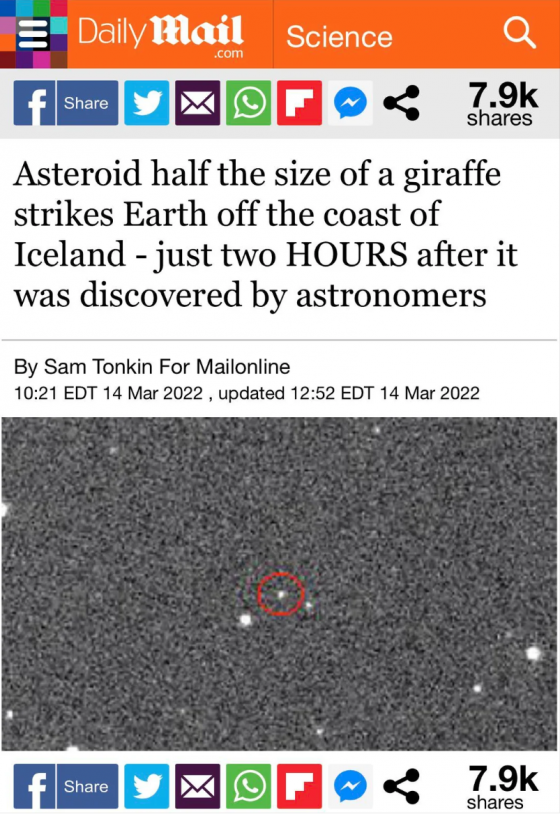
Giraffe-sized Asteroid

We live in a vast universe that spans enormous scapes of time and space. But humans evolved to understand information in relatable quantities at a human scale. We conceive landscapes mostly in chunks we can easily walk, connected loosely by strands of distances we can comfortably drive. We live in the now, but relate to the future in terms of a past that we dimly remember. We can make plans just within a very narrow scope of time — days, perhaps weeks. The future is always elusive and vague. We don’t comprehend spans of time outside of our experience. The span of a million years, ten million, a hundred million, or even just a thousand are concepts which we can intellectualize about but can’t really feel. Even in our interactions as members of a species, we can each just maintain a web of a few dozen relationships. Space, time, and human interactions are limited for us. We don’t process and, thus, don’t truly comprehend, information of large or very small scales that are beyond our direct experience. It’s not who we are as humans. This has all sorts of ramifications beyond the obvious. It’s why it’s easy for us to…

In-the-Moment Experience Versus Memory of Time

San Francisco Pride Month Laser Show by Bruce Andersen 2023

Time really does fly. It marches like an unstoppable force. But our memories of the past events and our perception of time are not so immutable. In-the-moment experience and the memory of such are so very different. Our memories are problematic, at best, and completely fictional at worst. But we can choose what we remember; we can shape our own history.

Musings About Time

sand hour clock

The past is gone. The future hasn’t happened yet. The present is a liminal space between two non-existent things. We’re encouraged to stay present and live in the moment. But who really does that? Primarily, it’s young children and adults under duress. Young children live in the moment; their time is now. A toddler of a certain disposition doesn’t understand that taking a nap now will make them happier later. That kind of thinking requires conceptualizing a future self and taking actions now for its benefit. Those concepts take time to develop. Children typically develop time perception roughly equal to that of an adult by about eight years of age. [(2021) Development of Young Children’s Time Perception: Effect of Age and Emotional Localization] Another set of humans who are trapped in the moment are people caught in disasters — be it wars, personal attacks, illness, weather events, or earthquakes. Like young children, these individuals are also anchored in the present. When faced with the immediate demands of a catastrophe, there is little room left to consider the past or the future. Typically, as adults, we find ourselves oscillating between the past and the future, seldom pausing to embrace the now.…

The Fragility of Normal

Fortune: May you live in interesting times

We all want to go back to normal. We cry about it and complain: “Enough is enough. We want our lives back.” This need to “go back to normal” is always with us, although maybe on a different scale post-pandemic. But even before Covid, there were always things that disturbed our perception of normal: new teachers, new housing, new jobs, new routines, stores and restaurants closing, cars that break down, challenging illnesses, new bus routes. Towards the end of our vacations, we come to realize that, although adventures are fun, it is good to be home where things are as we expect them to be. This want of predictability, for having our expectations met, is at the crux of a deep-seated need for normalcy. We have a limited capacity for taking in and processing information — we have limited short-term memories. When there is a flood of unfamiliar data, we get overwhelmed. We end up not having enough cognitive and emotional capacity to handle the new stuff on top of all the other things we have to do. Sudden change makes life feel overwhelming. Anchoring Errors This brings me to anchoring errors, which are basically little cognitive traps our minds…