
Monthly Archives: May 2014

Review eBook: Affordances and Design

Manches a Gigots

Victor Kaptelinin, a Professor at the Department of Information Science and Media Studies, University of Bergen, Norway, and the Department of Informatics, Umeaa University, Sweden, just published an eBook with Interaction Design Foundation: “Affordances and Design.” I was asked to write a review of this book and provide some insights into using affordances in interaction design and HCI. Let me start by providing the definition of affordance as given by Donald Norman: In his eBook, Victor Kaptelinin provides the history of the idea of affordance from its initial introduction by James Gibson in 1977 to the present day. The eBook’s bibliography and reference section is a great place to start the exploration of this topic for anyone new to these ideas. Unfortunately, the book doesn’t help much if an individual is looking for some guidance on how to apply these ideas in practical situations during interaction design or HCI design. For clarity’s sake, allow me to give a very brief explanation of affordances, from their roots to the present time. When James Gibson first introduced the concept of affordances, he focused on physical environment — what actions are possible? And the set of these action were invariable — just because…
Self-Marketing Ideas for Small Businesses, Non-profits, and Schools

Self-Marketing Ideas for Small Businesses

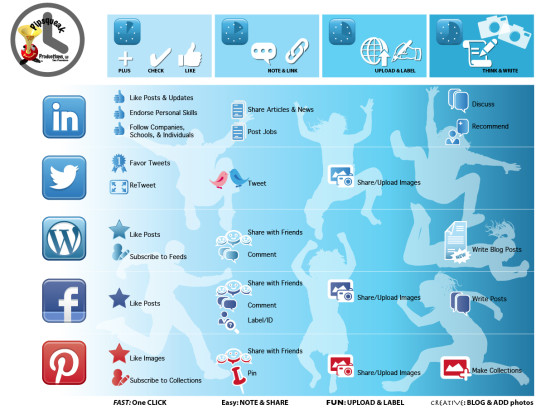
If you are running a small business, or a non-profit, or a school, marketing budgets tend to be very small. There’s just not a lot of money to spend. But institutions that are lacking in money can use time — of their volunteers, family, friends, staff, and students — to support their marketing and PR efforts and to generate some buzz about their organization, work, and services. The chart below focuses on just five media outlets: LinkedIn, Twitter, Facebook, Pinterest, and a blogging platform WordPress (other blogging SMS systems can be easily substituted). The idea is to spend time to continuously generate fresh and relevant-to-your-industry and audience content and then share it. Some things are very easy and don’t take much time: sharing articles and photos, tweeting and retweeting, liking and favoring, and pinning. Other activities take a bit more time: writing reviews and comments, creating galleries and image collections, etc. The hardest is blogging — this can take a lot of time and small organizations have to be careful how they allocate their time. But students and friends and volunteers can help. Used together, LinkedIn, Twitter, Facebook, Pinterest, and an organization blog, can form a powerful do-it-yourself marketing strategy: