
Tag Archive for e-reader

Generational Wealth in the Animal Kingdom

AI-squirrel with acorns

What other species of animals accumulate wealth over several generations? The other day, my husband and I were watching birds and squirrels dig around in our garden. “They are just trying to make a living,” my husband said. And it got me thinking — squirrels and birds have to find food and shelter everyday to survive. If they don’t find food, they go hungry. If they don’t find shelter, they suffer the elements and predators. Humans used to live the same day-to-day existence in our distant past. But now, we work hard to pass on the fruits of our labor to the next generation. But are there other animals that do the same? The largest known colony of ants is Linepithema humile, the Argentine ant. It has a contiguous colony from Northern Italy to South of France to the coast of the Atlantic in Spain — about 3,700 miles. It’s been around in Europe for about eighty years and is believed to have started in South America some 100 years ago. If there’s power in numbers and years, these 2 millimeter ants have it is spades. [https://www.guinnessworldrecords.com/world-records/largest-colony-of-ants] The largest colony of termites, another social insect, is over four thousand years…
Where to post the “OK” Button on the Screen?

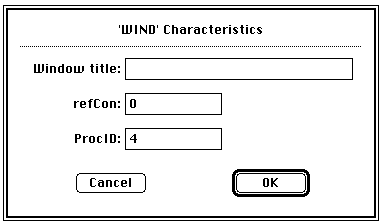
OK Button on Early Mac

I have very strong opinions about where on the screen the OK or NEXT or SUBMIT buttons go in relation to CANCEL. Without giving it away, I’m going to walk through the design decision tree and provide a lot of references for both sides of the issue — yes, there are strong feelings about the right versus the left position choice. I’m not alone! Passive versus Active Buttons Active Buttons are the ones that advance the action to the next level. Passive ones return the users to previous state, negate the action sequence. OKAY, OK, NEXT, SUBMIT, ACCEPT, GO are all active buttons. CANCEL, BACK, PREVIOUS are action that reverse forward momentum and push the user to places they’ve been before. HELP and INFO sidetrack the user and distract from forward thrust of activity. In general, product designers want to move the users toward their goals — thus we want the perceptual focus to be on the action buttons. We want to make sure that users fist see the way forward, and then click on the right button that propels them forward to completion of the task. All distractions and side movements should be downplayed with Interface Design with the…