Monthly Archives: April 2014

Perception of Value is Situational

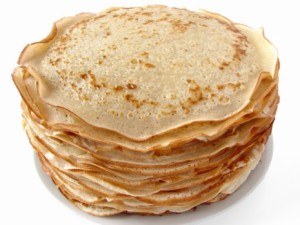
When you make pancakes, do you want them perfect? Perfect in taste? Perfect in texture? Perfect in shape? Who wouldn’t, right? When I cook, I want my creations to be pleasing to my audience (usually my family). Even on cooking shows, there’s a segment which helps home cooks make their creations look more professional — i.e. more perfect. As I was looking to buy a crepe-maker (non-electric), I read a bunch of reviews for all kinds of gadgets that promised a perfect crepe. One of the important criteria was the perfection of shape — a good crepe is circular, implying that a badly made crepe has irregular borders. There were all kids of clever inventions that helped the home cook achieve this circular perfection — molds, rakes, squeeze bottles, etc. At the end of my research, I got it — my crepes better be circular! But in others circumstances, this perfection of shape has a complete opposite perception of value. If you are buying frozen, pre-made crepes, then perfectly circular shapes signals “factory-made” or “made by robots” or “cookie-cutter crepes”. All of these are now derogatory things — who would want to eat crepes made by a machine? Untouched by…
Matters of Trust

call center experience

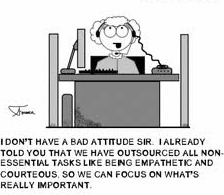
In the last few months I’ve started several new relationships. One was with BlueShiled of California — a relationship that was forced on me by the changing health insurance laws. The other came about from trying to find a place to stay in United Kingdom for our family vacation. I didn’t actively want these relationships, but here I am. And I am not very happy. The basic problem comes from the flow of trust. I’ve never heard of anyone else talk about the directionally of trust, but it is a very important concept to understand for any customer service oriented company. I will illustrate the idea using my new relationships. BlueShield Customer Service Failure! Let me start by saying that I wasn’t overly fond of my previous insurance company. In fact, that relationship was very much like this new one with BlueShield — antagonistic. My story begins in October of 2013, when I created a spreadsheet of all my family doctors versus possible new health insurance companies. I wanted to make sure that which ever insurance I picked, my family doctors would take it. I spent the afternoon making phones calls and ended up with BlueShield of California as my…

When Design and Interface are Dictated by the Technology

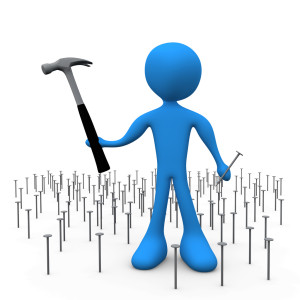
You’ve probably heard: If you have a hammer, everything looks like a nail. This is a commentary on how our problem solving perspective is influenced by the tools we happen to have in our hands at that moment. The tools, of course, don’t have to be physical. They can be systems, or lists, or a set of approaches that we’ve learned at school or that are enforced at work. And they can also be digital tools that we feel particularly comfortable using. These “tools” constrict our metal models, limiting the possible solutions to the design problems we face at work (or at home). It’s not a surprise that if we Google “WordPress Templates,” all the results look more or less the same. This is partly because of the tool — WordPress is a great tool, but as any tool, it limits the final creative output to what is easy. (Especially, if the designer is not a programmer.) Here’s a look at Google Image results for “WordPress Screenshots”: What’s interesting is the flip side of this phenomenon. Once we see a lot of nails, we expect nails as the solution. So it is not a surprise that not only do most…