
In the world of business, the writing process is often ignored. Complete thoughts are shortened to bullet points. Proofreading is considered a luxury, resulting in spelling errors or missing words. Content requirements go overlooked. This video for a large healthcare nonprofit started with a great vision and the outline of a several unique stories. The director created story boards with captions describing each scene but since there were no speaking parts in the video, a script was never written. The models in the video were merely supporting characters to the story’s real stars: the mobile apps. We used the app development process as a proxy for the writing process. The “script” was written into wireframes. However, the words that appeared on the mobile devices needed to be written as a separate document. But because a writing process was not followed, copywriting was done directly in the wireframes, resulting in overly complex wireframes in a format that was inaccessible to the producers. Too often, producers are more concerned with headlines and big pictures, not details. But just as in any app development process, each button needs a label, each alert needs a message, each form field needs a caption, each instruction needs…
Monthly Archives: November 2013
Conceptual Design, Cultural Differences, Ethnographic & User Data, Language, Pipsqueak Articles
Language and Cultural Differences in Communication
by Olga Werby •
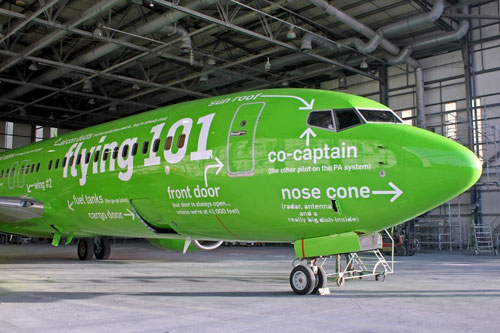
Above is an example of Interface Design — Kulula Airlines decorates its planes in a very playful manner. Does this choice make you feel safer or more reticent to fly their planes? Well, that depends… Consider the FAA Passenger Briefing Guidelines: 14 CFR 91.519. Below are a few examples: § 91.519 Passenger briefing. (a) Before each takeoff the pilot in command of an airplane carrying passengers shall ensure that all passengers have been orally briefed on: Smoking. Each passenger shall be briefed on when, where, and under what conditions smoking is prohibited. This briefing shall include a statement, as appropriate, that the Federal Aviation Regulations require passenger compliance with lighted passenger information signs and no smoking placards, prohibit smoking in lavatories, and require compliance with crewmember instructions with regard to these items; Use of safety belts and shoulder harnesses. Each passenger shall be briefed on when, where, and under what conditions it is necessary to have his or her safety belt and, if installed, his or her shoulder harness fastened about him or her. This briefing shall include a statement, as appropriate, that Federal Aviation Regulations require passenger compliance with the lighted passenger sign and/or crewmember instructions with regard to…
Background Knowledge, Background Knowledge Errors, Language, Pipsqueak Articles
Scary Translations
by Olga Werby •
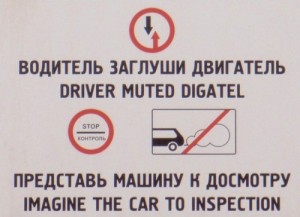
Happy Day of the Dead! To celebrate the day after Halloween, I decided to scare my readers with a few translations that I have been gathering from emails sent to me over the years. Look closely — it’s not that they are completely wrong, rather they fail in very unique ways. Enjoy!