
Benjamin Mason Meier, Assistant Professor of Global Health Policy, is one of the creators of the Global Health and Human Rights Database. Benjamin and his colleagues wanted to collect information on different forms of legal tools used around the world to advance the human rights in health. Here is a link to his paper describing the project: “Bridging international law and rights-based litigation: Mapping health-related rights through the development of the Global Health and Human Rights Database.” I was interested in seeing his data on the map. So I used an open source project CartoDB to plot Benjamin’s data on the map. And here’s a quick visualization. Now I’m interested in comparing the resulting map with The World Bank eAtlas of Global Development maps. In particular, it would be interesting to compare GDP with focus on health-based human rights.
Monthly Archives: September 2013
Conceptual Design, Pipsqueak Articles, Reference
Health, Human Rights, and Maslow’s hierarchy of needs
by Olga Werby •
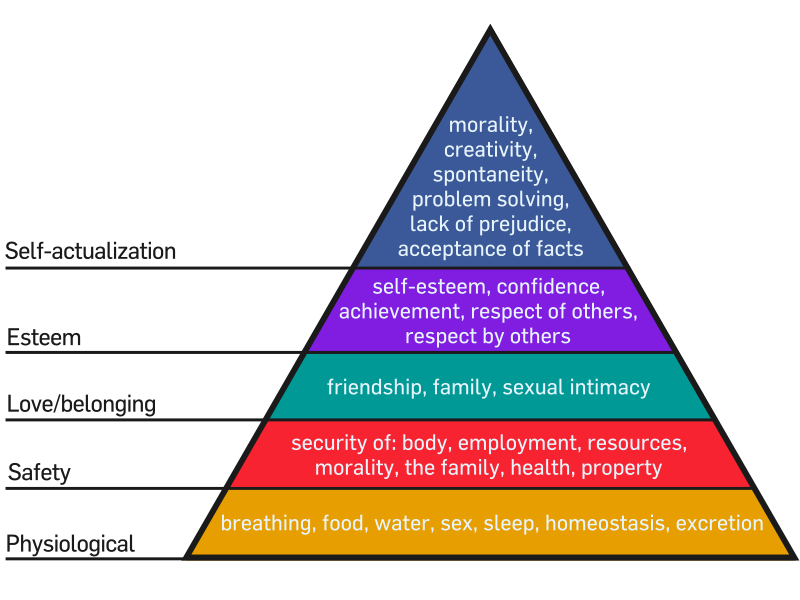
In 1943, Abraham Maslow published a paper on human motivation: “A Theory of Human Motivation.” The ideas (and diagram) from that paper have been widely used in business schools and management training programs. But these same ideas can be applied to human rights. The Universal Declaration of Human Rights, signed into life by UN General Assembly on 10 December 1948, just five years after the Maslow’s publication of “A Theory of Human Motivation”, echoes the work via a set of Articles stating the rights of every human being. Physiological Needs Article 25 of The Universal Declaration of Human Rights states that everyone is entitled to the right of adequate food (and presumably water is included), housing and clothing (for homeostasis control), and medical care. The right to medical care implies to me the right to live healthy, or at least healthy to the best of ability of a particular individual. This right to medical care as a universal right of all human beings can be interpreted to mean many things. For the purposes of the comparison to the Maslow’s Hierarchy of Needs, it could be interpreted as every human has the right to have their physiological needs met. This could…
Background Knowledge, Pipsqueak Articles, Reference
Health and Human Rights
by Olga Werby •

I have been collecting some background materials for Health and Human Rights and would like to share a few resources. United Nations Documents The Universal Declaration of Human Rights — Article 25 directly address health: (1) Everyone has the right to a standard of living adequate for the health and well-being of himself and of his family, including food, clothing, housing and medical care and necessary social services, and the right to security in the event of unemployment, sickness, disability, widowhood, old age or other lack of livelihood in circumstances beyond his control. (2) Motherhood and childhood are entitled to special care and assistance. All children, whether born in or out of wedlock, shall enjoy the same social protection. The right to the highest attainable standard of health : . 08/11/2000. Health is a fundamental human right indispensable for the exercise of other human rights. Every human being is entitled to the enjoyment of the highest attainable standard of health conducive to living a life in dignity. The realization of the right to health may be pursued through numerous, complementary approaches, such as the formulation of health policies, or the implementation of health programmes developed by the World Health Organization…
Attention, Attention Controls Errors, Perceptual Blindness, Pipsqueak Articles
Perceptual Focus Error
by Olga Werby •
Early on in my academic career, I did research in a middle school classroom. Computers were just introduced to a bunch of kids that never experienced them directly before. There were very few computers in schools at the time, and students were bunched up in groups around each one. One kid got to sit and control the keyboard, another student controlled the mouse. (I bet you know the genders of these two kids.) Most kids just focused their attention on the screen. The task was to familiarize with how the desktop computer interface worked. At the end of the activity, I got to interview the kids. One of the surprises was how many of the kids didn’t associate the movement of the mouse with the action on the screen. To connect the two actions together, a kid would have had to know that mouse movements and a pointer were related. It was not an obvious observation, especially in a tight crowd of a student group around the computer screen. And to this day, this required double focus is difficult for kids on the Autistic spectrum (iPads are much more intuitive for this population). One of the conclusions of my study…