
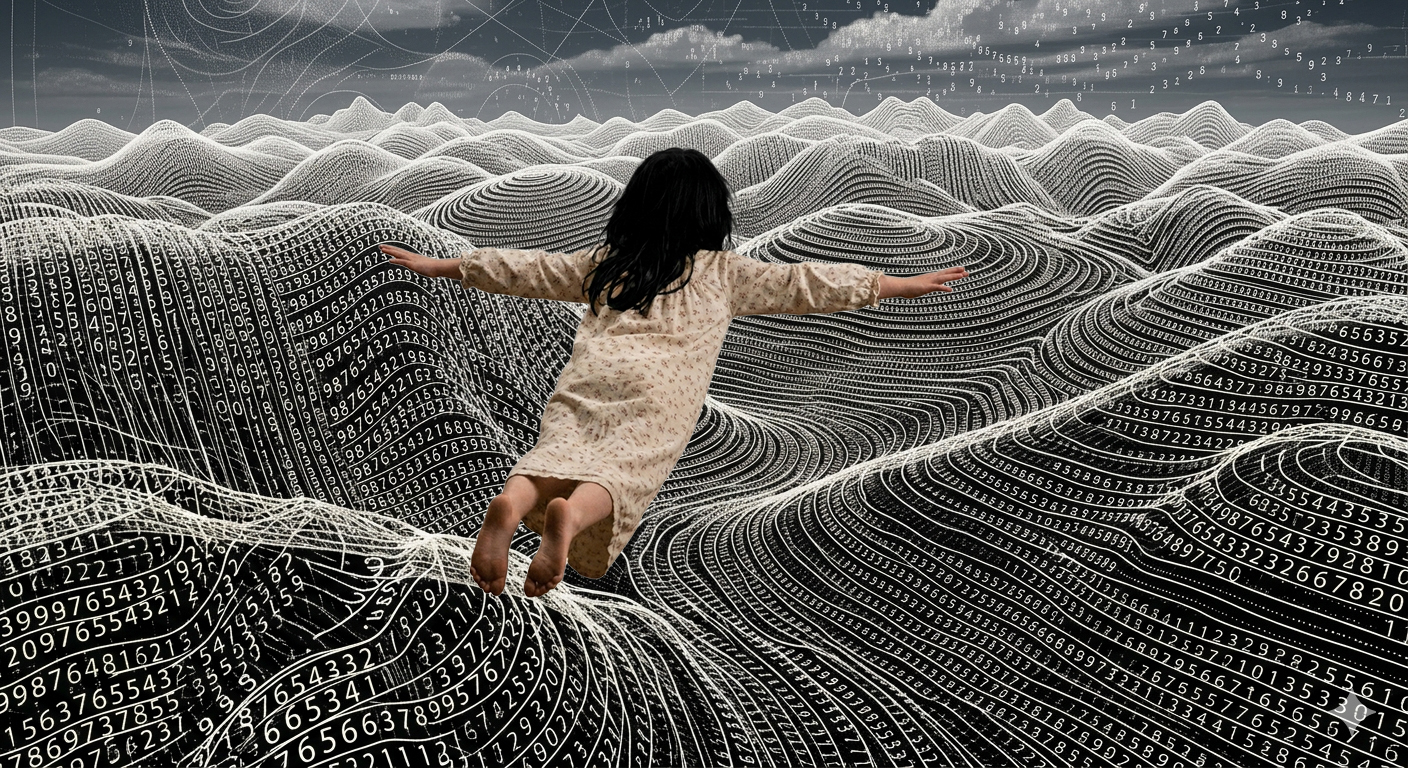
When I was a kid, I slept in my grandparents’ bedroom. First in a crib, then on a little couch in the corner of their room. My grandfather taught me math every night before I fell asleep. He drilled me on addition, subtraction, then multiplication. He used large numbers; and I always got the right answer. It was easy for me. Numbers formed a complex landscape that I could fly over. In the darkness, my grandfather would rattle out a problem — 337 + 781, for example — and I would fly over the beautiful hills and valleys until the answer would be right there. I loved that game. I then I would try to fall asleep really fast because my grandfather snored so loudly that if I didn’t I would never be able to due to the horrific noise. We played that game for years, until I was displaced from my grandparents’ room by my younger sister.
I am currently reading a popular book on neurology, “The Man Who Tasted Words: A Neurologist Explores the Strange and Startling World of Our Senses” by Dr. Guy Leschziner. It explores many human variations in sensory perception either from birth or as the result of an accident or medical problem. Our nervous system is very complex and things can easily go haywire. The case studies discussed in the book are far from the norm of human perception: some are joyous, some are tragic, but all are fascinating.
To me, the most interesting insight was how to think about perception. What we perceive with our senses — the colors, textures, tastes, sounds, aromas, positions in space, and so on — are really just our brains’ interpretation of the external and internal signals we get from our body. It’s no small miracle that we all agree as much as we do. The color red is red! Chocolate smells good. Sugar is sweet. Such agreement across cultures, eons, and even animals is nothing less than amazing. I remember back in grad school reading about studies that gathered data across different indigenous populations to nail down the reddest version of the color red. The agreement was remarkable! We all share the same perceptual hallucination, the same “virtual reality” that our brains create for us to help us navigate the world we live in and to make predictions and facilitate actions that help us survive.
Our brains have to work hard to create reality that we experience. Take visual information. We only have a tiny spot in our eye that sees clearly, the rest is blurry. We also have a “blind” spot where our retina is joined to our brain by the optic nerve. So our brains basically have to fill in the gaps to make the best guess they can all the time about what it is we are seeing. And signals don’t travel instantaneously; it takes time for the pain of a stubbed toe to get transmitted to your brain, for example. We’ve all had that “uh oh” experience as we wait for the pain to come. And yet we have to move about our lives, avoiding obstacles, making decisions how to keep safe.
Dr. Leschziner puts it like this: “Essentially, our brains work as guessing machines, interpreting what is coming in through our senses in the context of our model of the world. What we perceive relates to our existing beliefs about the world, to how the information our senses provide us with interacts with our virtual-reality simulation of the universe. … Without an element of prediction, the system would break down. … And so, this idea of ‘controlled hallucination’ recognizes the concept that while our senses are vital to understanding the world around us, our perception of the world is firmly rooted in our brain’s own virtual reality. What the senses are telling us feeds into this simulated environment to help us understand these signals. When our senses clash with our own internal view of the world, this may give rise to illusions like those described above or, in extreme situations, when our inner simulation is more chaotic or frenzied, full-blown psychosis.”
And anywhere in this complex system, things can go wrong due to disease or accident or development. People experience letters and numbers as colors or music. Some are only able to see a subset of colors that a majority can sense. We all know people who lost their sense of smell and taste due to COVID. Things happen. Humans adapt. There are many books that describe the strange world of our senses. I love everything Oliver Sacks had ever written. And I strongly recommend “The Man Who Tasted Words” by Dr. Guy Leschziner. It’s a fun ride.
While I can still remember flying over the mathematical landscape, I can no longer do what I could as a kid. Numbers and mathematical formulas don’t resolve into fantastical lands in my mind’s eye, displaying the answers to all things mathematical. In retrospect, I think I had a form of numerical synesthesia — numbers and geometrical landscapes were fused in my perception. So what happened? When I was in first grade, I was pushed down a flight of stairs. I ended up with a broken nose and a concussion. I also lost my ability to fly in the math lands of my mind. “Perception is nothing more than a controlled hallucination” is a commonly used sentence in cognitive neuroscience. I loved mine and mourn its loss, although I did end up with a math degree.
I have written about synesthesia — the mixing of the senses — in several of my books, but most of all in my first one: Suddenly, Paris. I’ve made this book available for free for the next few days, starting April 15th. Happy Tax Day and happy reading.