
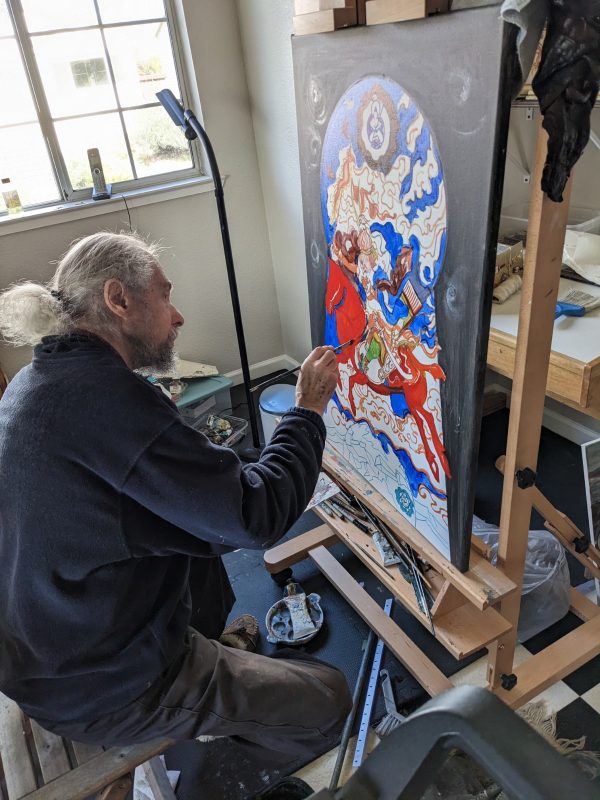
My dad has always been a very talented artist, brimming with imagination, creating sculptures, jewelry, and paintings even as he enters the second half of his eighties. As child, he survived the holocaust; he starved; he lost family and friends in WWII and in the Cold War that followed; and he is a refugee. He now has dementia. His art started changing some years back, perhaps one of the early symptoms of his failing mind. My dad’s older brother was also very creative and artistically gifted, even as he pursued science as opposed to art as his professional career. My uncle too succumbed to dementia some years back. So I’ve been cogitating on imagination and dementia. In particular, I’m thinking a lot about the wast diversity of cognitive differences that make up humanity. Do these cognitive differences manifest different dementia symptoms? How can they not, right?
Aphantasia is inability to “see” images in one’s mind’s eye. 1% of the population has this condition. While those of us who don’t have it might be shocked by such lack of ability, there are some advantages: it’s easier to move on from loss and trauma. People with aphantasia are less prone to PTSD — out of sight out of mind. And, of course, there are some negatives too. Unsurprisingly, in studies that compared aphantasiacs to people with average ability to form images in their minds, people with aphantasia didn’t perform as well on tasks that required visual cognition and visual working memory. And, what’s more, they were not aware that they suffer from such deficits. [Jacobs C, Schwarzkopf DS, Silvanto J (August 2018). “Visual working memory performance in aphantasia”. Cortex; A Journal Devoted to the Study of the Nervous System and Behavior. The Eye’s Mind — visual imagination, neuroscience and the humanities. 105: 61-73. doi:10.1016/j.cortex.2017.10.014. PMID 29150139.]
Here are a few discussions of aphantasia: https://www.youtube.com/watch?v=Xa84hA3OsHU and https://en.wikipedia.org/wiki/Aphantasia
There is also an audio version of this: auditory aphantasia — inability to hear internal dialog or music in one’s mind outside of external sources. People with aphantasia often report accessing their memories via language — words trigger the recollection. In effect, aphantasiacs tell stories to themselves. Individuals with auditory aphantasia, on the other hand, seem to store information in a more visual way, accessing memories by images. I’m not sure if there are documented cases of people who have both aphantasia and auditory aphantasia. And I don’t have a clear “image” of how they store and access information, but that would certainly be very interesting to study.
Like all cognitive traits, abilities are places on a continuum. If there is auditory aphantasia, then there are people who are particularly great at “hearing” music and voices and sounds, even outside of external stimulus. This would be Hyper Auditory Phantasia. And it is under control of the individual — they are able to recall sounds at will in their mind’s ear with great fidelity. Musical Ear Syndrome, on the other hand, is hearing music or song so vividly that it might come as shock that it is only “playing” in one’s head. And yes, that can get annoying. The music might not be to one’s liking, for example, in addition to making it difficult to hear the sounds of the world. [https://myhearingcenters.com/blog/what-is-musical-ear-syndrome/] Musical Ear Syndrome tends to develop after a physical trauma. Beethoven had a prolific musical imagination. Did it turn into a Musical Ear Syndrome as he become deaf? We will probably never know.
On the other end of the spectrum from aphantasia is Hyperphantasia. It accounts for about 3% of the population. [https://www.cell.com/trends/cognitive-sciences/fulltext/S1364-6613(24)00034-2]. People with hyperphantasia are able to form mental images in hyper detail. Such images are so realistic that sometimes it is difficult to tell dreams from memories from reality.
If I had to classify myself and my dad, we would both be on the far end of the hyperphantasia spectrum. This trait runs in our family. My cousin has it. Her dad, my dad’s brother, had it. When I write, I can see the story and all of the characters in minute detail in my mind. I can feel what they feel in extreme vividness. When I paint, I often find that my fingers are just “too stupid” to put down on canvas what I see in my head. It’s very frustrating. I think this is true for my dad as well — he can “see” his work in his mind’s eye far more clearly than he sometimes can express in a tangible medium. He can also remember things from his childhood that were so intense that it’s like reliving them again. My dad never got over the hanger he felt as a child and is always afraid of running out of food. I believe PTSD is much more difficult to recover from when one has such a heightened ability to relive the pain in all of its details. So this brings me back to dementia. My dad has visual and audio hallucinations. It’s difficult for him to tell the difference between what’s real and what is just a story his imagination is telling him. Does hyperphanasia make dementia worse? I think so. When it is so hard to see a difference between what’s real and what’s imaginary, how can it not?
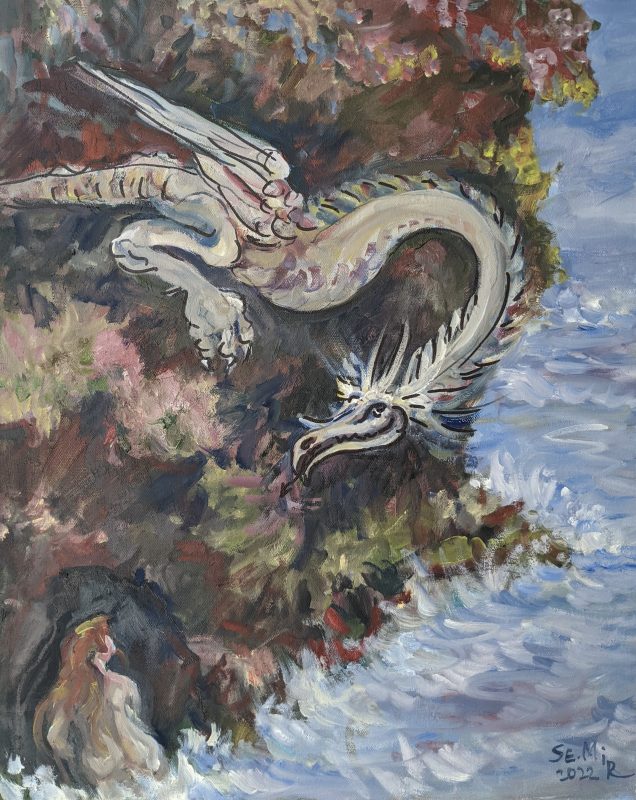
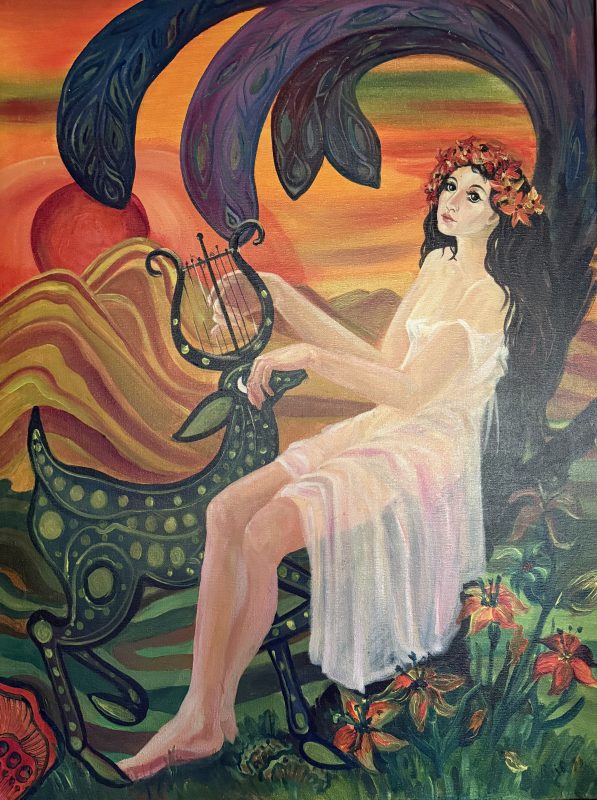
I wish my dad had fantastical voyages into happy lands. But it is not so. He had experienced some very difficult things in his life. He can’t help but remember them, relive them. He is confabulating wildly, mixing reality and fantasy in extraordinary ways. I wish the results were not as dark. But it is not only the subject matter, the color pallet and level of detail changed. My dad has always worked very fast. But now speed turned everything into muddy scribbles, it seems. The first image is from 2022, the one blow is from 1980. It’s still the same artist, but things have changed.
My dad is an artist, and hyperphantasia is probably a big positive for this career choice. But aphantasia might be a plus to other fields of endeavor. Greg Venter, a human genome scientist [https://en.wikipedia.org/wiki/Craig_Venter] is an aphantasiac. So was Oliver Sacks, the most amazing neurologist and a great writer [https://en.wikipedia.org/wiki/Oliver_Sacks]. Glen Keane was an animator for Disney and had aphantasia [https://en.wikipedia.org/wiki/Glen_Keane]. Did lack of ability to form metal imagery help or hinder their careers? It obviously made a difference, but of what kind?
The range of humanity and its cognitive traits are extraordinary. These “invisible” human differences have an impact on how we live our lives. And writers can put a spotlight on these differences through analogy, allegory, metaphor, and empathy. We can give a glimpse of this incredible expanse of experience to our readers. So go grab a book!