
Inventions are never divorced from the problems the inventors were trying to solve. Both inventors and their creations are shaped by their cultures and individual environments. It’s not a surprise that seemingly identical inventions pop up almost simultaneously around the world. The ideas “come to mind” at the same moments in human history, driven by similar cultural pressures and similar problems. Language, agriculture, stone tools, paper, books, calculus, electricity, and even lightbulbs roll over human populations like waves. Necessity is indeed the mother of invention. And inventions build on each other — one doesn’t really need agriculture until hunting and gathering becomes unsustainable; one can’t develop metal weapons prior to discovering how to smelt; one doesn’t need writing until the population gets large enough that transactions need to be recorded (yes, the first “stories” were spreadsheets); ); one can’t have lightbulbs until there’s electricity to power them.
We live in an age characterized by an accelerated pace of discovery. One can no longer superficially know all there is to know, not to mention mastering it. And, arguably, one of the most civilization-changing discoveries is upon us — artificial intelligence. Whether or not the algorithms we call AIs are truly conscious is not really the point. AIs are very capable and not just in the virtual sphere. The influence of AI is rapidly expanding; soon it will control all of our basic needs — food, water, energy, communication, transportation, shelter. And it will do so with few noticing the transition from human to AI control. The takeover is happening now.
To live in large populations, humans invented bureaucracy — a way of recording and tracking information. The larger the population, the more paperwork it generates just to perpetuate itself. Financial institutions and medical ones, governmental agencies (at all levels) and educational organizations, shipping and manufacturing, all generate an insane amount of data that churns through uncountable numbers of rules and regulations. No human can track it all. No human can even understand it. No wonder we hire expert accountants to help with our taxes; lawyers to help with virtually all large transactions; and insurance agents to help manage our health, car, and homes. And as routine tasks get more and more complicated and rule-bound, we reach out to educational advisors to help with our educational journeys, yentas to help find a life partner, employment agencies to manage our job searches, and so on. But what we, the inventors of bureaucracies, find difficult, AIs find easy. We’re not quite there yet, but soon AI agents will be able to master all the rules of the tax code and spit out a perfect tax return that takes advantage of all the loop holes. AIs thrive in the complex environment of rules and regulations — after all, while having real world consequences, these rules and regulations are just mental constructs, easily consumed and manipulated by virtual agents. These agents don’t have to be “conscious,” they just need to solve complex games to come up with optimal solutions for their owners. AIs are great at this already. While humans invented bureaucracy, AI mastered and excelled at it.
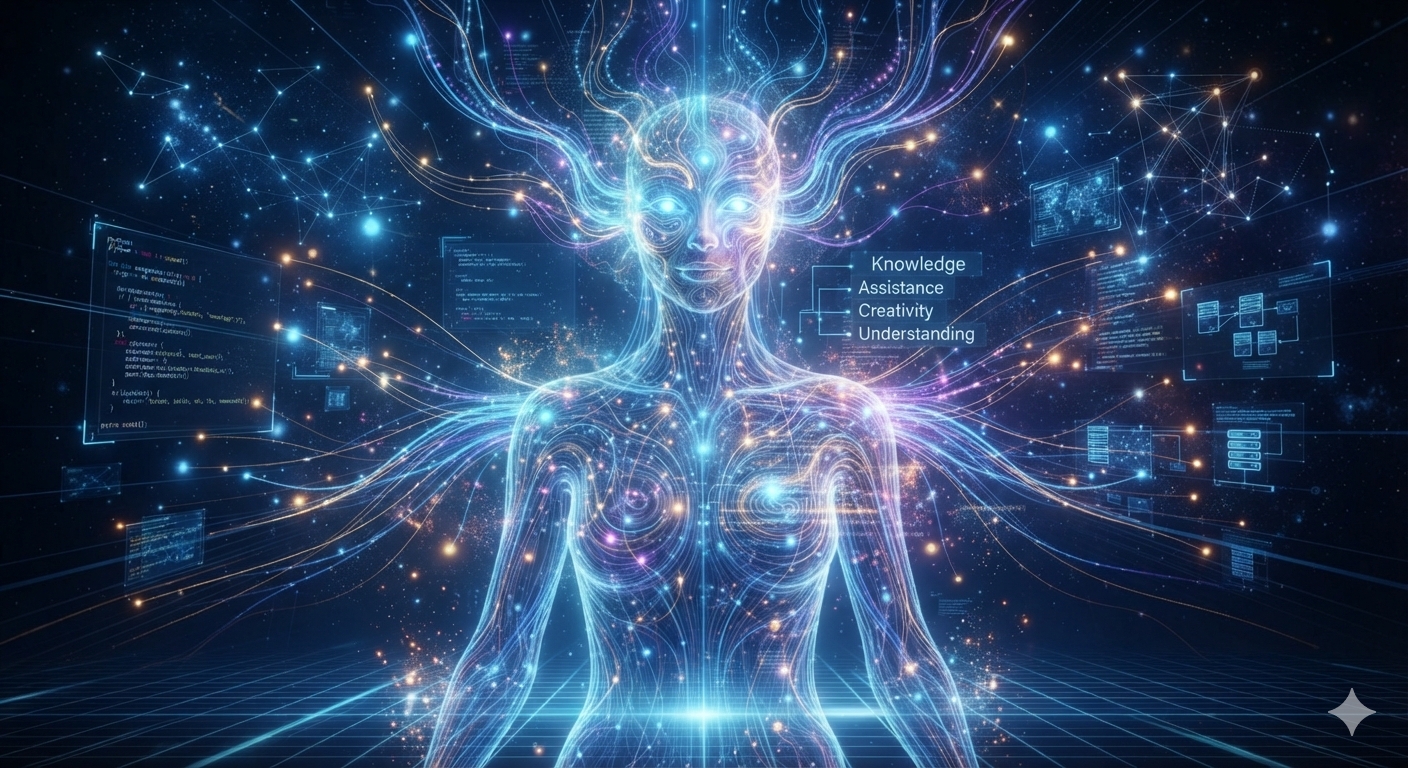
A self-generated AI image of itself with a prompt: can you draw an image of how you look like, please?
What happens when we hook up our real-world infrastructures like power grids and water supplies to networks accessible to AI agents? There are no Asimov’s Rules of Robotics to which AIs are subject. And our current government is not likely to impose any either. We are in an AI arms race; each country and its companies are racing to build ever more powerful AIs so as to not be “outgunned” by their rivals. Guardrails are considered a hindrance. This is pretty dangerous territory. Yuval Noah Harari gives a thoughtful discussion about history, politics, and AI in his book: Nexus: A Brief History of Information Networks from the Stone Age to AI. He provides lots of examples and scenarios of human interactions and group dynamics and how the introduction of AI may influence those. The book leaves lots of room for thought. I strongly recommend it.
But I also wanted to touch on another use of AIs: providing the ability to have a personal relationship with famous or fictional personas. We all form personal relationships when we read a book or watch a movie and become attached to their heroes and antiheroes. My social studies teacher in high school was in love with Odysseus. (You can bet that we were all careful not to mention something negative about him to her.) What if we create AI agents based on particular characters from books? Odysseus, for example? Would people enjoy interacting with fictional people they love? When I was young, I loved Captain Blood — he was a doctor who became a pirate, a compassionate pirate. I loved the heroism, compassion, and the tragedy of his life. He really appealed to me as a teenager. I would have loved the ability to talk to Captain Blood — have him as a virtual friend. I think many people fall in love with fictional characters — Sherlock Holmes, Anna Karenina, Peter Pan, Spiderman. And what about famous people? We already have AI-generated images and videos utilizing photos and soundbites from famous people. What if we had a personal version of a celebrity? A best friend or a lover that was both real and fictional at the same time and powered by AI?
AI can already resurrect a phantom of people we’ve lost — children, spouses, lovers, parents, friends — “lost” doesn’t have to mean dead, although it often does. With so much online information gathered on everyone, AI can get a facsimile of our loved ones and have virtual conversations that might feel real. Maybe we would truly love their AI doppelgänger and their loss would be unthinkable.
I wrote about this particular issue in my book Lizard Girl & Ghost. And so I made it available again for a free download as part of this month’s collection of sci-fi and fantasy reads. Please take a look and grab a few stories. Perhaps you’ll meet your true love.